
Workplace First Aid
Qualsafe Level 3 First Aid at Work (FAW) Course in Manchester
Our First Aid at Work course in Manchester leads to the Qualsafe Level 3 Award in First Aid at Work (RQF), the regulated qualification for appointed workplace first aiders. Delivered as blended learning, it combines one online day with two practical classroom days at our Levenshulme centre. You'll learn to manage cardiac arrest, bleeding, injuries and medical emergencies, and the certificate is valid for three years.
- Classroom days run 9am to 5pm
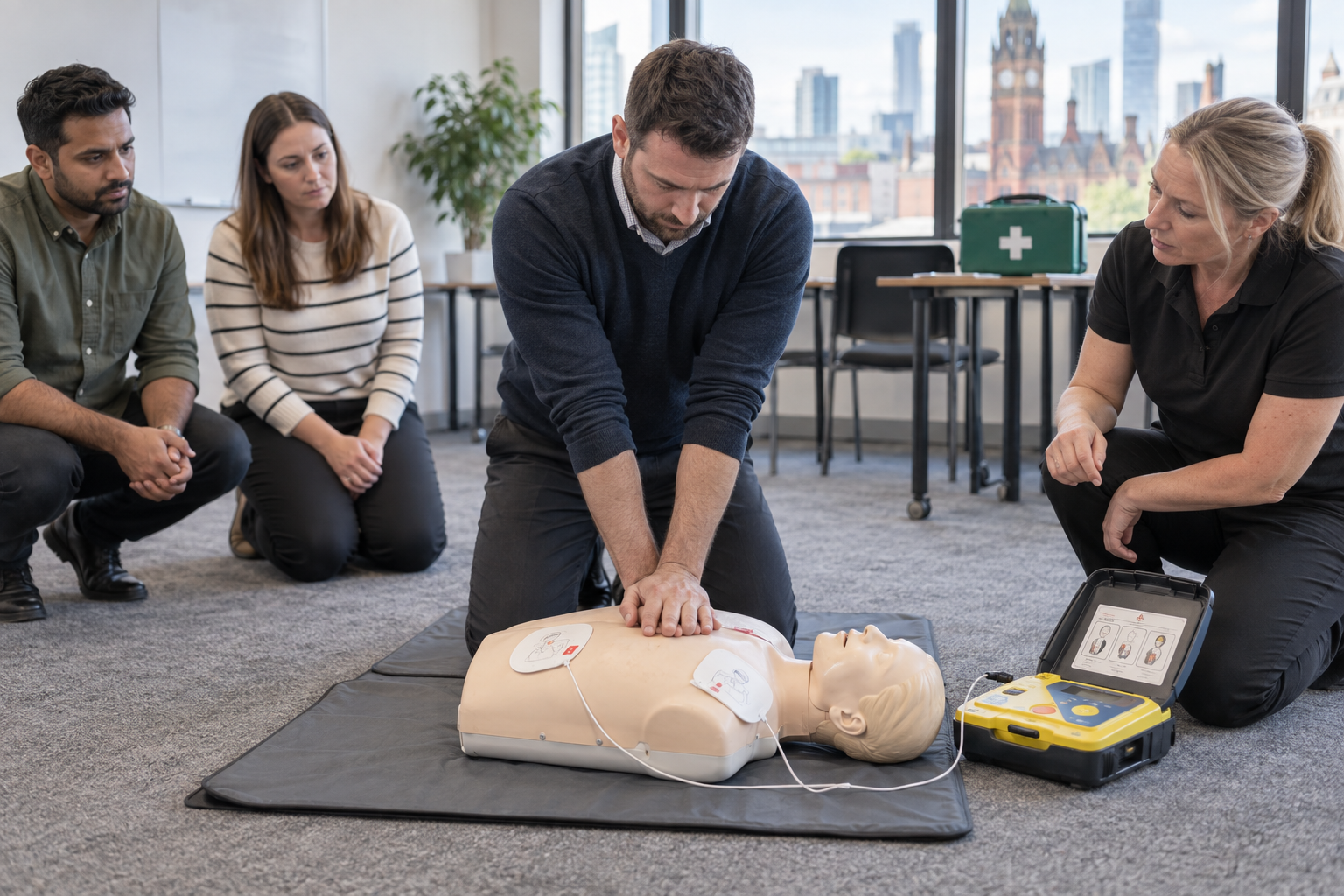
- Scenario-based practice with modern CPR and AED kit
- Structured instructor feedback throughout
- Free dedicated car parking at the centre
- Free on-road parking nearby
- Group places available from 2 people
- On-site training for groups of up to 12
- Bring photo ID to the classroom days
Course summary
- Qualification
- Qualsafe Awards Qualsafe Level 3 Award in First Aid at Work (RQF)
- Duration
- 3 days
- Format
- 1 day online learning + 2 days face-to-face practical training
- Location
- Manchester
- CPD
- 18
- Certificate valid for
- 3 years
- Price
- £195
- Next date
- Sunday 15 – Monday 16 November 2026
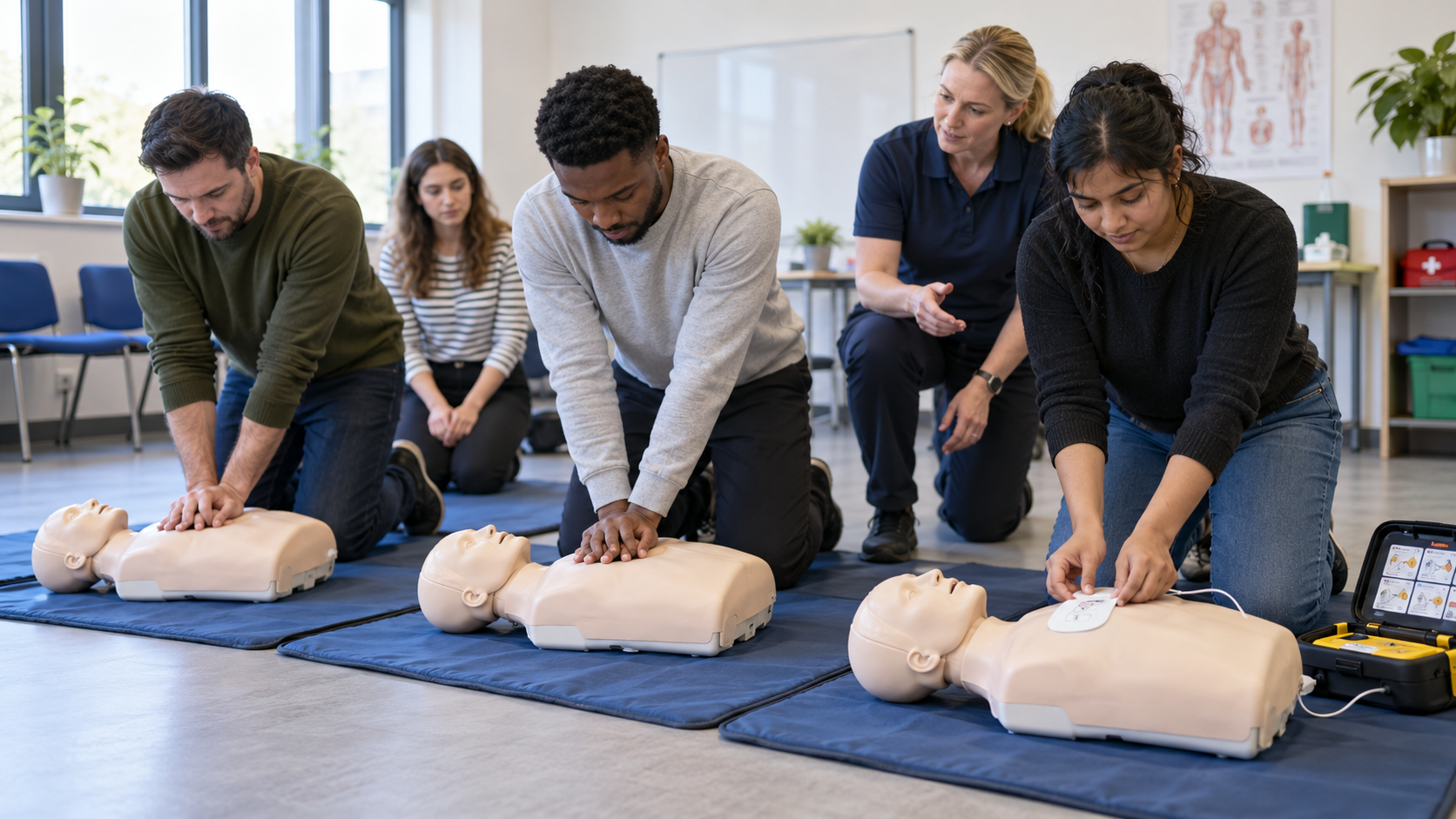
First Aid at Work training in Manchester for appointed first aiders
If your employer's first-aid needs assessment calls for a fully qualified first aider, this is the course for you. Our First Aid at Work course in Manchester goes well beyond the emergency skills of the one-day EFAW course, preparing you to deal with fractures, burns, seizures, diabetic emergencies, anaphylaxis and much more.
The course is blended: one day of online learning and two hands-on classroom days in Levenshulme, where you practise every skill until you can perform it confidently under assessment. Successful candidates gain a regulated Qualsafe Level 3 Award.
Choose a date below to secure your place.
Why train with PLAB Guide in Manchester
We are a Qualsafe Awards Approved Centre in Levenshulme, and our first aid training is built around the situations first aiders actually face at work.
- Qualified, experienced instructors who give you structured feedback on every skill
- Scenario-based practice using workplace-focused emergency simulations
- Modern CPR and AED training equipment for realistic, hands-on practice
- Free parking in our dedicated car park, with free on-road parking nearby
- Flexible booking for individuals, groups on our dates, or private courses at your site
Our aim is simple: you leave competent and confident, not just certified.
Further reading
- How many first aiders does my workplace need?: What HSE guidance says, and how to choose between EFAW and FAW.
Upcoming First Aid at Work course dates in Manchester
From £195
Book this dateMore dates
Choosing a date takes you straight to booking with that date selected.
Course overview
First Aid at Work is the most in-depth workplace first aid course we run. It covers everything taught on Emergency First Aid at Work, then adds the recognition and management of a much wider range of injuries and illnesses, from fractures and suspected spinal injuries to strokes, diabetic emergencies and heat-related illness.
The course runs as blended learning over three days in total. One day is completed online, and the other two are spent with an instructor in our Levenshulme classroom from 9am to 5pm. Classroom time is practical and hands-on: demonstrations, individual and group exercises, CPR and AED practice, choking and bleeding-control drills, and realistic injury and medical-emergency scenarios.
Your instructor assesses you continuously as you work, alongside the required theory assessments, and gives structured feedback so you always know where you stand. The syllabus also covers the practical side of the role: infection prevention, consent, prioritising treatment, calling the emergency services and recording incidents correctly.
Who this course is for
This course is for anyone appointed, or about to be appointed, as a qualified first aider at work. It suits workplaces where the first-aid needs assessment points to higher risks, larger numbers of staff or visitors, shift or lone working, or a long distance from emergency services.
You'll come away able to take charge of an incident, treat a casualty with confidence and hand over clearly to the ambulance crew. Your employer remains responsible for deciding which level of first aid training your workplace needs.
Who should attend
- Employees appointed as workplace first aiders
- Construction, engineering and manufacturing staff
- Warehouse, transport and logistics teams
- Care-home and healthcare support staff
- School and education staff
- Hospitality, retail, sports and leisure teams
- Security personnel
- Supervisors and managers
- Self-employed professionals and volunteers with first-aid duties
Entry requirements
To complete the qualification you must:
- Complete the online learning day
- Attend and take full part in both classroom days
- Bring photo ID to the classroom days
What you will learn
- Assess an emergency scene safely and carry out a structured casualty assessment
- Deliver effective adult CPR and use an AED safely
- Manage an unresponsive breathing casualty using the recovery position
- Recognise and treat mild and severe choking
- Control external bleeding and recognise and manage shock
- Manage fractures, spinal, head, chest and abdominal injuries, burns and eye injuries
- Recognise and respond to heart attack, stroke, seizures, asthma, diabetic emergencies and anaphylaxis
- Hand over a casualty safely and record workplace incidents correctly
Course content
-
1 The role of the workplace first aider
Your responsibilities and limits as a first aider, and how to keep yourself, the casualty and bystanders safe. Covers infection prevention, consent, respectful communication, first aid equipment and workplace arrangements.By the end of this part you will be able to:
- Explain the limits of your role as a workplace first aider
- Apply infection-prevention measures when giving first aid
- Complete accident reports and records accurately
-
2 Assessing an emergency
A structured approach to any incident: check for danger, assess responsiveness, open the airway, check breathing and identify life-threatening conditions before calling for the right help.By the end of this part you will be able to:
- Identify hazards before approaching a casualty
- Check responsiveness, airway and breathing in the correct or
- Decide when and how to call the emergency services
-
3 CPR, AED and the unresponsive casualty
Recognise cardiac arrest, deliver high-quality chest compressions and rescue breaths, and prepare and operate an AED. You'll also manage an unresponsive casualty who is breathing, including vomiting and signs of deterioration.By the end of this part you will be able to:
- Minimise interruptions to chest compressions
- Position AED pads correctly and follow the prompts
- Monitor a casualty in the recovery position
- Recognise deterioration that requires CPR
-
4 Choking
Recognise mild and severe choking and act quickly, from encouraging an effective cough to back blows and abdominal thrusts, and arrange medical follow-up afterwards.By the end of this part you will be able to:
- Tell mild choking from severe choking
- Give back blows and abdominal thrusts
- Manage a choking casualty who becomes unresponsive
-
5 Bleeding, wounds and shock
Control minor and life-threatening bleeding, use dressings safely and deal with embedded objects. Learn to recognise the signs and symptoms of shock and keep the casualty reassured and monitored.By the end of this part you will be able to:
- Apply direct pressure and dressings effectively
- Treat a wound with an embedded object
- Recognise shock and call for urgent help
-
6 Injuries to bones, muscles and joints
Recognise and manage fractures, dislocations, sprains and strains, as well as suspected spinal, head, chest and abdominal injuries, with the emphasis on avoiding unnecessary movement.By the end of this part you will be able to:
- Support suspected fractures and dislocations
- Keep a casualty with a suspected spinal injury still
- Recognise serious head, chest and abdominal injuries
-
7 Burns, scalds and eye injuries
Immediate care for thermal, chemical and electrical burns and scalds, and for eye contamination, foreign objects in the eye and serious eye injuries.By the end of this part you will be able to:
- Give immediate first aid for burns and scalds
- Recognise the extra risks of chemical and electrical burns
- Respond to eye contamination and foreign objects
-
8 Medical emergencies
Recognise and respond to heart attack, stroke, seizures, asthma attacks, diabetic emergencies, anaphylaxis, fainting, poisoning, heat exhaustion, heatstroke and hypothermia.By the end of this part you will be able to:
- Recognise the warning signs of heart attack and stroke
- Help a casualty during an asthma attack or anaphylaxis
- Respond safely to seizures and diabetic emergencies
Course format
- Duration
- 3 days
- Made up of
- 1 day online learning + 2 days face-to-face practical training
- Delivery
- Online learning followed by practical classroom workshops, scenarios and assessment
- Online learning
- 9am – 5pm each day
- Classroom
- 9am – 5pm each day
Assessment
- How you are assessed
- Continuous assessment by your instructor through practical demonstrations and observation, plus the required theory assessments.
- Practical assessment
- Observed demonstrations of CPR, AED use, choking management, bleeding control and casualty management throughout the classroom days.
- Written assessment
- Theory assessments as required by Qualsafe Awards.
Certification
- Requirements
- Complete the online learning, attend and take full part in both classroom days, and demonstrate competence in every practical skill and the theory assessments. Booking and attendance alone do not guarantee a pass.
- Certificate valid for
- 3 years
Your instructors
Rashad Raza
Instructor and IQA
MBBS MRCS
Doctor by profession with extensive experience as a clinician in the hospital.

Simon Scott
Senior Resuscitation Instructor
HCPC-Registered Operating Department Practitioner
Simon brings over 25 years of clinical experience in anaesthetics — including adult and paediatric cardiac theatres — intensive care and emergency response across NHS and independent healthcare settings. As a former Senior Resuscitation Officer, he has extensive experience delivering Resuscitation Council UK adult and paediatric life support training to healthcare professionals from a wide range of clinical backgrounds. Since qualifying as an instructor in January 2017, Simon has served as faculty on ALS, ILS, EPALS and PILS courses. His clinical practice covers managing deteriorating patients, attending cardiac arrests, supporting adult and paediatric anaesthetic emergencies, undertaking inter- and intra-hospital transfers, and participating in out-of-hours resuscitation teams.
Training near you
PLAB Guide Training Centre delivers Qualsafe Level 3 First Aid at Work (FAW) Course in Manchester, convenient for learners travelling from Levenshulme, Longsight, Didsbury, Gorton, Stockport and surrounding areas.
Related courses
You may also like
-
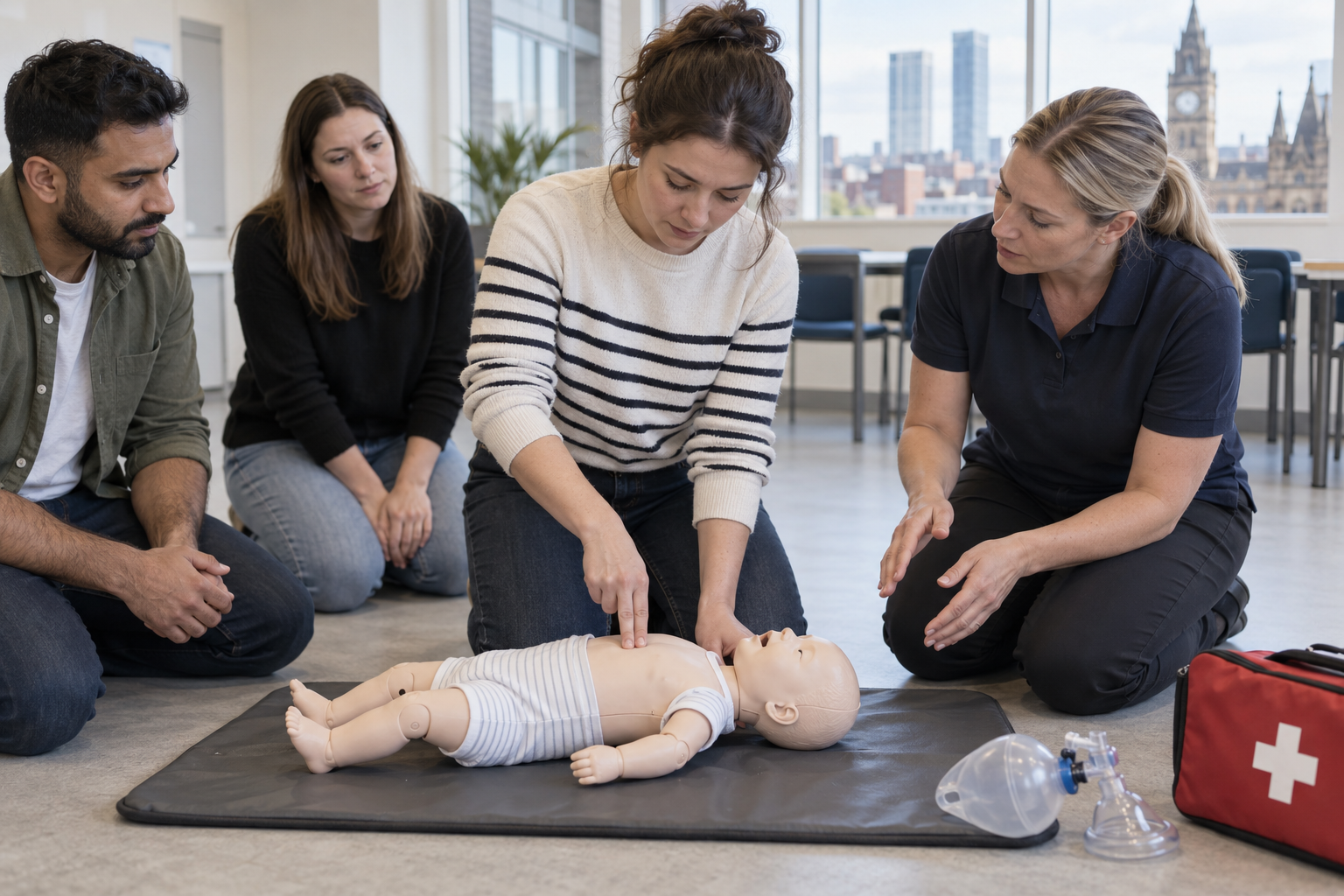 View course
Level 3 Paediatric First Aid (PFA) Course in Manchester
Our paediatric first aid course in Manchester leads to the Qualsafe Level 3 Award in Paediatric First Aid (RQF), a full two-day qualification designed to meet the Early Years…
Mon 23 Nov, PLAB Guide Training Centre
12 places available
-
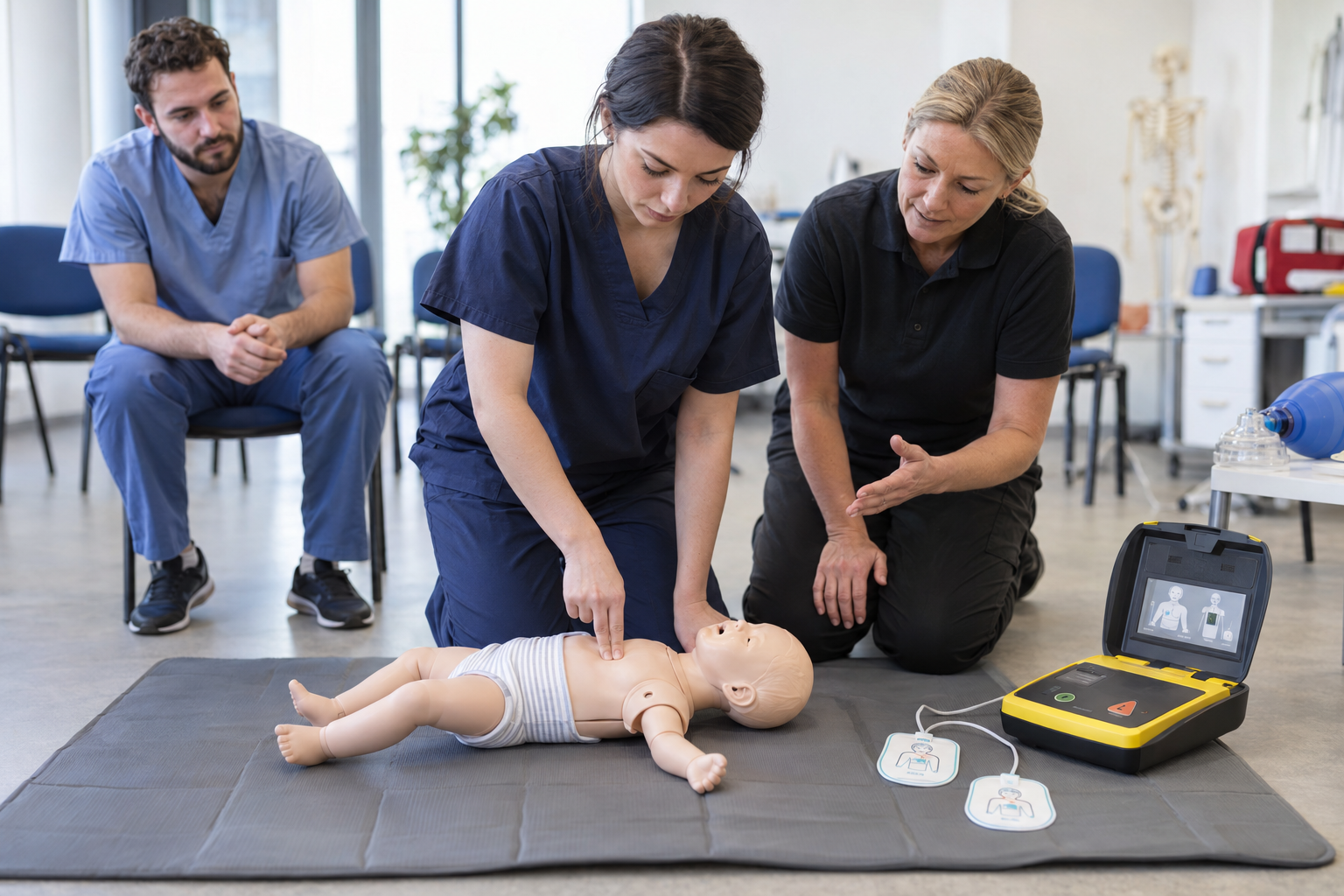 View course
Basic Life Support (BLS) and AED Course in Manchester
Our BLS course in Manchester is a one-day, hands-on Qualsafe Level 3 Award in Basic Life Support and Automated External Defibrillation for Adults, Children and Infants (RQF). You…
Mon 16 Nov, PLAB Guide Training Centre
12 places available
Alternatives
-
 View course
Emergency First Aid at Work (EFAW) Course in Manchester
Our Emergency First Aid at Work course in Manchester is a one-day, hands-on programme that leads to the Qualsafe Level 3 Award in Emergency First Aid at Work (RQF). It is built…
Mon 9 Nov, PLAB Guide Training Centre
12 places available
See all Workplace First Aid courses
Frequently asked questions
Is the First Aid at Work course fully classroom-based?
Do I need any first aid experience before booking?
How is First Aid at Work different from Emergency First Aid at Work?
How long is the certificate valid, and what happens when it expires?
Is this qualification recognised by employers?
Can you run the course at our workplace?
Can my employer pay for my place?
Does attending the course guarantee I will pass?
Ready to book?
The next date with places is Sunday 15 – Monday 16 November 2026
Book now