
Advanced & Specialist Life Support
Newborn Life Support (NLS) Course in Manchester
The Newborn Life Support (NLS) course in Manchester is a one-day Resuscitation Council UK provider course for doctors, midwives, nurses and paramedics who care for babies at birth. You will learn a structured approach to assessing the newborn, opening the airway, delivering inflation and ventilation breaths and starting chest compressions when needed. Successful candidates receive the RCUK NLS Provider certificate, valid for four years.
- Official RCUK NLS manual sent before the course
- Pre-course online MCQ paper
- Hands-on airway and mask ventilation practice
- Newborn resuscitation manikins and simulation
- Small-group practical teaching
- Structured instructor feedback
- Free dedicated parking at the venue
Course summary
- Qualification
- Resuscitation Council UK Resuscitation Council UK Newborn Life Support (NLS) Provider certificate
- Duration
- 1 day
- Format
- Face-to-face
- Location
- Manchester
- CPD
- 5 CPD points
- Certificate valid for
- 4 years
- Price
- From £250
- Next date
- Friday 20 November 2026
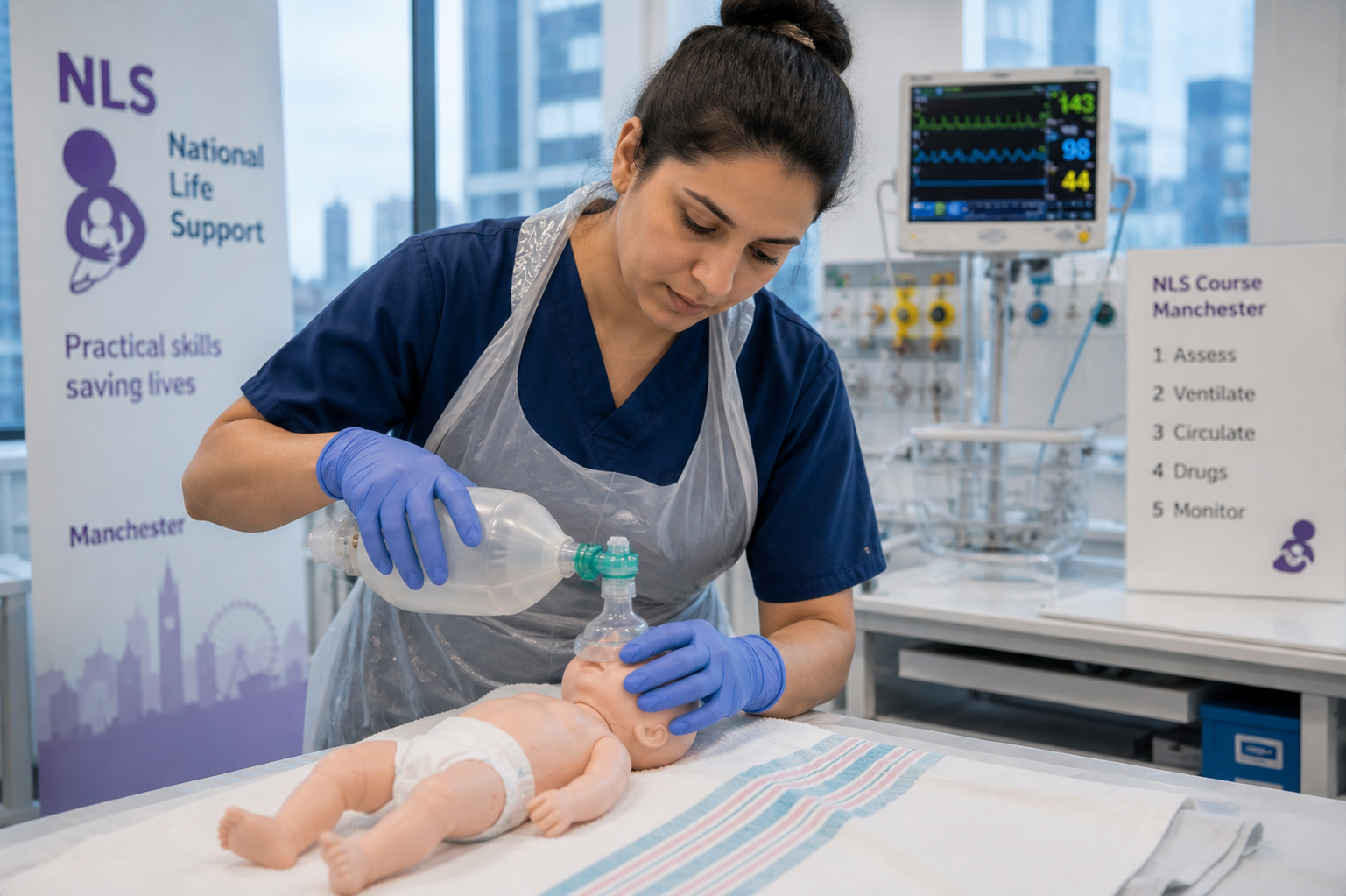
NLS training in Manchester for the first minutes after birth
Most newborns start breathing without help. When one doesn't, the next few minutes depend on a calm team working to a clear plan. Our NLS course in Manchester gives you that plan: keep the baby warm, position the airway, inflate the lungs, then check that your ventilation is actually working before you move on to anything else.
This is a practical day. You will work with newborn manikins at skill stations and in simulated deliveries, with instructors giving feedback as you go, and finish with the RCUK practical assessment. Pick a date below and book early: the official NLS manual is sent to you ahead of the course, and you will want time to read it and complete the pre-course MCQ.
Why train for NLS with PLAB Guide in Manchester
Newborn resuscitation is a skill many clinicians use only occasionally, so the time you spend with your hands on a manikin counts. We keep practical groups small, so everyone gets hands-on time with mask ventilation and airway troubleshooting rather than watching from the back.
- Experienced newborn resuscitation faculty who explain the reasoning behind each step, not just the sequence.
- Realistic simulation using newborn resuscitation manikins, with structured feedback from your instructor.
- Modern facilities in Levenshulme, with free dedicated parking, free on-road parking nearby and convenient road and public transport links.
Further reading
- What to expect on an APLS course in Manchester: Eligibility, online learning, the two face-to-face days and how to prepare.
Upcoming dates
£250
Book this date£265
Book this dateMore dates
Choosing a date takes you straight to booking with that date selected.
Course overview
NLS is a one-day Resuscitation Council UK provider course centred on one situation: a newborn who needs help to establish breathing at birth. It teaches a single structured approach that you apply in the same order every time, with effective lung inflation and ventilation at its heart.
Lectures cover the physiology of the transition from intrauterine to extrauterine life, and how problems during it lead to apnoea, bradycardia, poor respiratory effort, cyanosis or reduced tone. That background explains why newborn resuscitation differs from adult and paediatric life support.
Practical skill stations then cover thermal care, airway positioning, mask seal, inflation breaths and ventilation, and chest compressions coordinated with breaths. You bring these together in simulated newborn resuscitation scenarios, working as a team, calling for help and reassessing heart rate after each intervention.
The course ends with a formal practical assessment of newborn airway management and ventilation. Instructors give structured feedback throughout, so you can correct your technique while you practise.
Who this course is for
This course is for healthcare professionals who attend deliveries or care for babies in the minutes after birth, whether on a labour ward, in a neonatal unit, in the emergency department or before hospital. It suits you if you want a dependable routine for a newborn who is slow to breathe. It also gives you more confidence with mask ventilation and airway troubleshooting, and practice working as a team before you face the situation for real. NLS is a strong addition to a maternity, neonatal, paediatric or acute-care portfolio, and may help you meet a training or employment requirement.
Who should attend
- Paediatric and neonatal doctors
- Obstetric doctors and anaesthetists
- Emergency medicine doctors
- Foundation and specialty trainees
- Midwives
- Neonatal and paediatric nurses
- Advanced neonatal nurse practitioners
- Paramedics and resuscitation officers
- Other eligible healthcare professionals involved in newborn care
Entry requirements
You must hold a professional healthcare qualification or be training towards one.
Before the course
- Read the official NLS manual, which is sent to you in advance. Resuscitation Council UK advises that it arrives around one month before the course.
- Complete the online MCQ paper.
- Familiarise yourself with the NLS algorithm.
This is the full provider course. It is for candidates who are new to NLS, or whose previous certificate falls outside the recertification eligibility window. Come ready to take part fully in the practical sessions and the assessment.
What you will learn
- Assess a newborn rapidly at birth and recognise when intervention is needed
- Minimise heat loss and keep the baby warm throughout resuscitation
- Position and open the newborn airway and achieve an effective mask seal
- Deliver inflation and ventilation breaths and confirm they are effective
- Correct ineffective ventilation using a structured airway approach
- Start chest compressions when indicated and coordinate them with ventilation
- Recognise when advanced help is needed and hand over safely after stabilisation
- Communicate clearly and share tasks within a newborn resuscitation team
Course content
-
1 The transition at birth
Why some babies struggle to adapt to life outside the womb, and how this appears as apnoea, bradycardia, poor tone or cyanosis. Explains why newborn resuscitation follows different priorities from adult and paediatric life support. -
2 Initial assessment and thermal care
A rapid first assessment of tone, breathing and heart rate to decide whether the baby needs help. Practical steps to reduce heat loss from the moment of delivery. -
3 Airway management and ventilation
Head positioning, mask placement and seal, inflation breaths and ongoing ventilation. How to judge chest movement and work through a structured sequence to fix ventilation that isn't working. -
4 Chest compressions and further support
When compressions are indicated, hand position, technique and depth, and coordination with ventilation. Reassessing heart rate to judge response, the role of oxygen, and when to call for advanced help. -
5 Team simulation and stabilisation
Simulated deliveries in which you lead and support newborn resuscitation as a team. You allocate tasks, share findings, keep situational awareness and hand over safely once the baby is stable.
Course format
- Duration
- 1 day
- Delivery
- Lectures, practical skill stations and newborn resuscitation simulations
Assessment
- How you are assessed
- A formal practical assessment of newborn airway management and ventilation, held on the course day.
- Practical assessment
- Assess the newborn, position and manage the airway, deliver effective ventilation, recognise whether it is working and correct it if not.
- Written assessment
- Online MCQ paper, completed before you attend the course.
Certification
- Requirements
- Complete the pre-course MCQ, take part fully in the course and pass the practical airway and ventilation assessment. Booking a place does not guarantee successful completion.
- Certificate valid for
- 4 years
Training near you
PLAB Guide Training Centre delivers Newborn Life Support (NLS) Course in Manchester, convenient for learners travelling from Levenshulme, Longsight, Burnage, Gorton, Didsbury and surrounding areas.
Related courses
You may also like
-
 View course
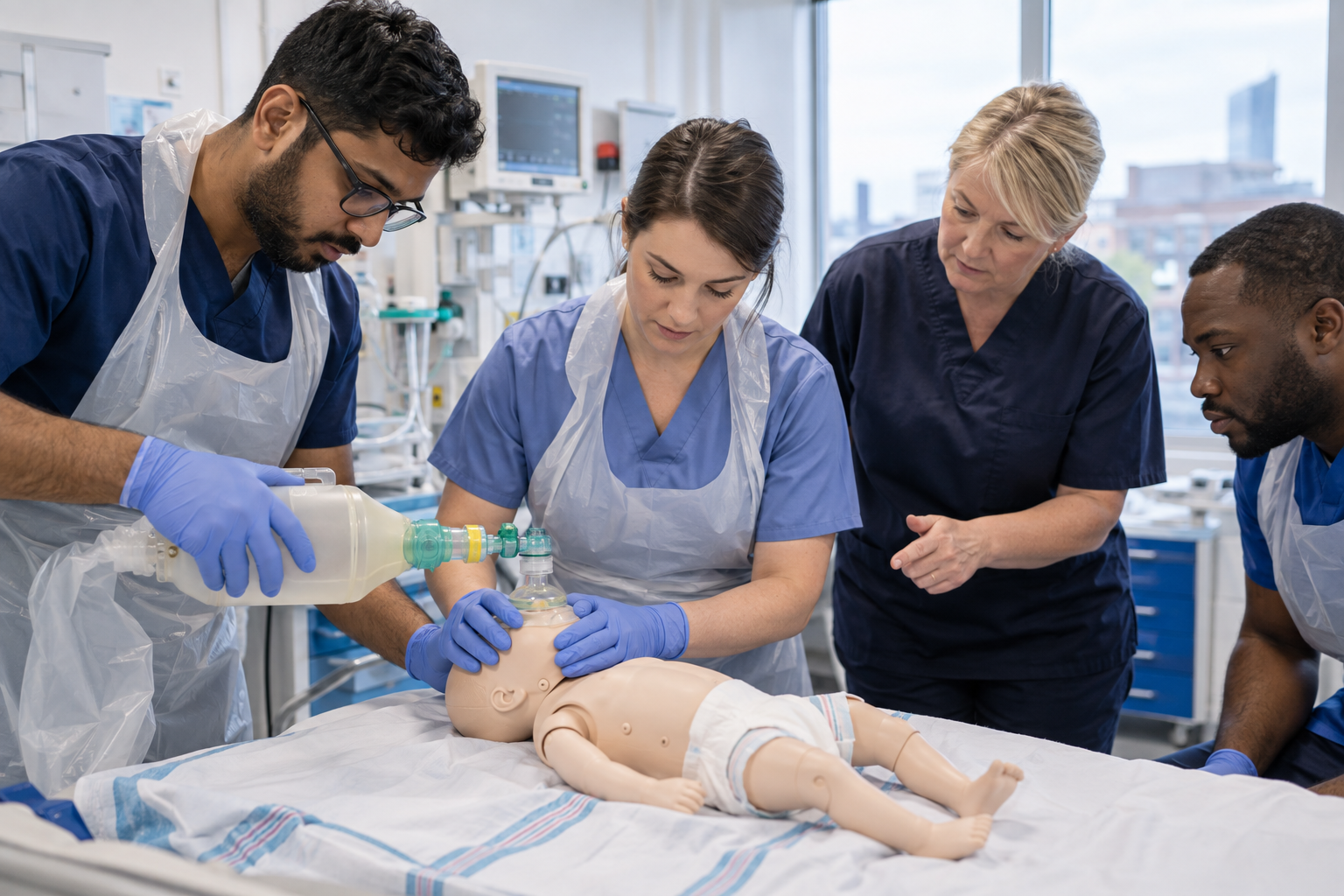
European Paediatric Advanced Life Support (EPALS) Course in Manchester
Our EPALS course in Manchester is the Resuscitation Council UK European Paediatric Advanced Life Support provider course, run over two days at PLAB Guide Training Centre in…
Sat 7 – Sun 8 Nov, PLAB Guide Training Centre
Fast selling, 6 places left
-
 View course
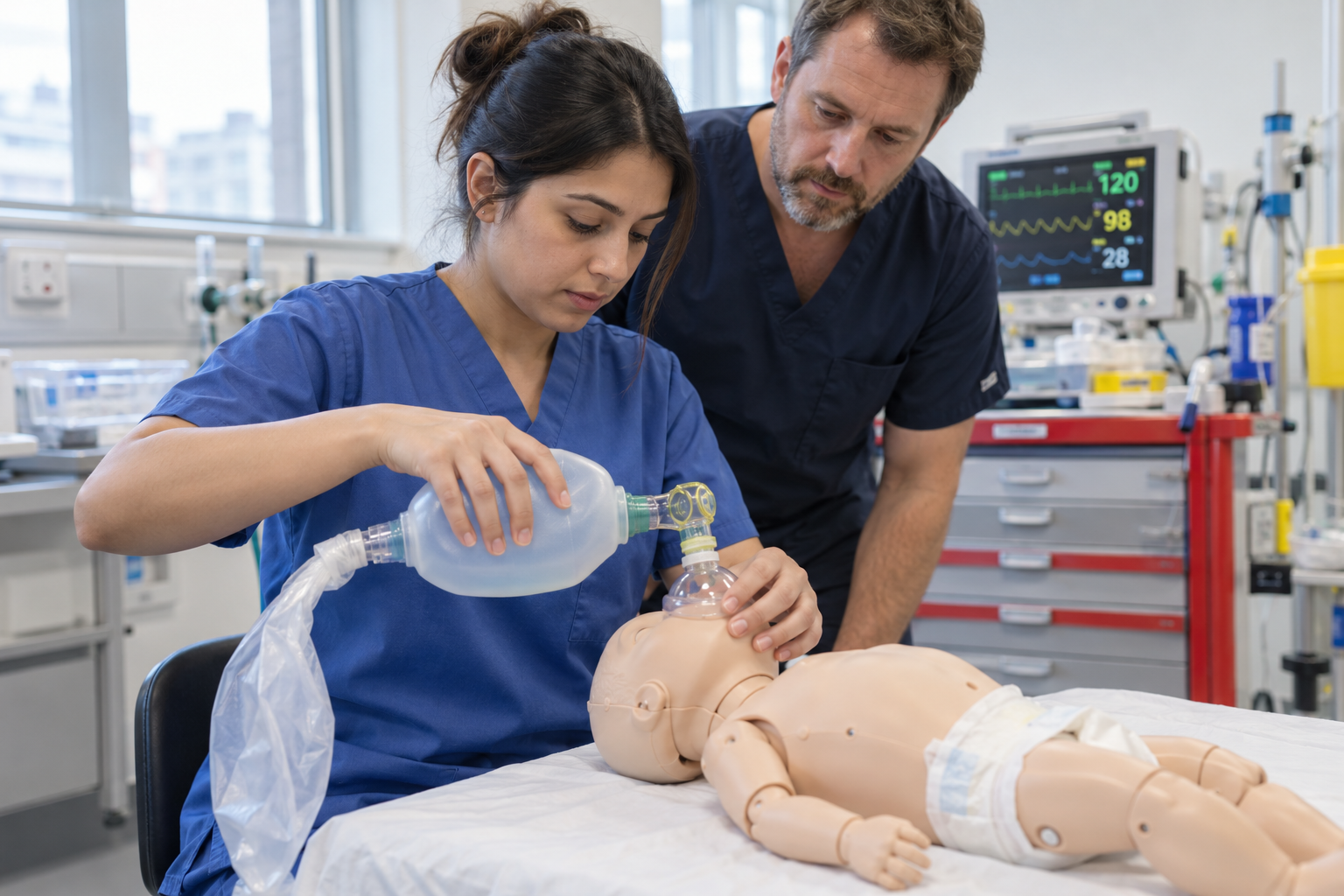
Paediatric Immediate Life Support (PILS) Course in Manchester
This PILS course in Manchester is the Resuscitation Council UK Paediatric Immediate Life Support course, delivered as ePILS: online learning in your own time, then a half-day…
Fri 6 Nov, PLAB Guide Training Centre
5 places available
See all Advanced & Specialist Life Support courses
Frequently asked questions
How much does the NLS course in Manchester cost?
How long is the NLS certificate valid?
Should I book the full NLS course or NLS Recertification?
What preparation do I need to do before the NLS course?
Who can attend the NLS course?
How is the NLS course assessed?
Does NLS count towards CPD?
How is NLS different from PILS or EPALS?
Is there parking at the training centre?
Ready to book?
The next date with places is Friday 20 November 2026
Book now