
Venepuncture and Cannulation Course in Manchester
Our venepuncture and cannulation course in Manchester is a practical, one-day clinical skills programme for doctors, nurses and other healthcare professionals. Learn safe blood collection in the morning and peripheral IV cannulation in the afternoon, with plenty of supervised practice on realistic training arms. Book one half-day session or the full day, which earns 6 CPD points and a certificate of completion.
- Morning: phlebotomy and venepuncture
- Afternoon: peripheral IV cannulation
- Book one half-day session or the full day
- Realistic venepuncture and cannulation training arms
- Small-group teaching with individual feedback
- Supervised practical skills assessment
- Free dedicated parking and free on-road parking
Course summary
- Course
- Venepuncture and Cannulation Course in Manchester
- Duration
- 1 day (two half-day sessions)
- Format
- Face-to-face
- Location
- Manchester
- CPD
- 6
- Certificate valid for
- 2 years
- Price
- From £135
- Next date
- Wednesday 14 October 2026
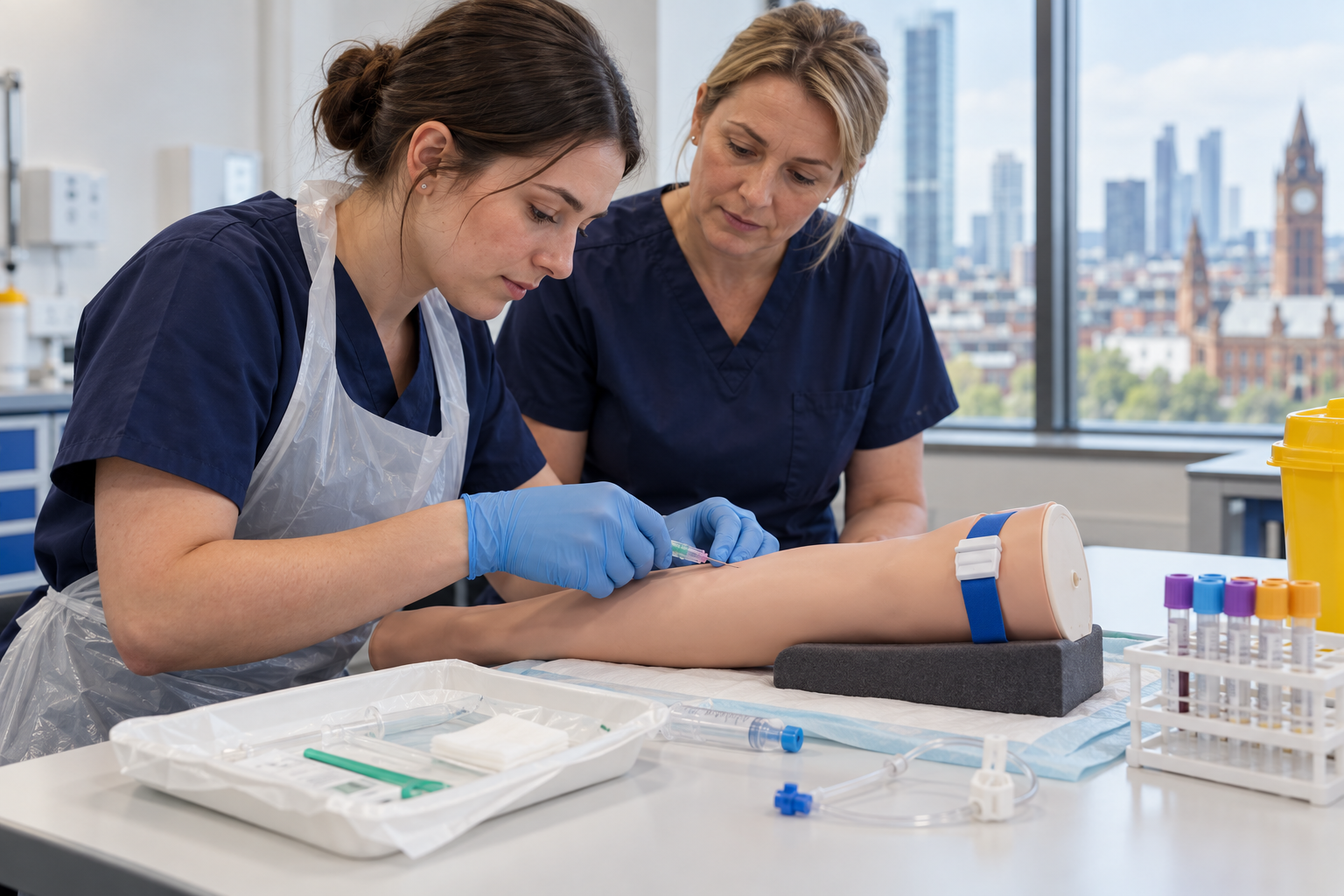
Hands-on venepuncture and IV cannulation training in Manchester
Our venepuncture and cannulation course in Manchester gives you focused, practical time on the two vascular access skills you are most likely to use on the ward, in clinic or in the community. The day runs as two half-day sessions at our Levenshulme training centre: phlebotomy and venepuncture in the morning, peripheral IV cannulation in the afternoon.
You can book the session you need or stay for the full day, which carries 6 CPD points. Whether you are learning these procedures for the first time, returning to practice or getting ready for workplace sign-off, you will spend much of the day practising on realistic training arms with an instructor beside you. Choose a date below to reserve your place.
Why book the full day at PLAB Guide Training Centre
Venepuncture and cannulation share the same foundations: venous anatomy, vein assessment, communication, infection prevention and safe needle handling. Taking both sessions on the same day lets you build those skills in the morning, then apply them straight away when you move on to peripheral IV access in the afternoon.
- Small-group teaching with individual technique correction and structured feedback from experienced healthcare instructors
- Repeated practical attempts on realistic venepuncture and cannulation arms, using modern clinical equipment
- Training relevant to UK healthcare settings, including knowing when to stop and escalate
- Free dedicated parking at the centre, plus free on-road parking nearby
Upcoming venepuncture and cannulation course dates in Manchester
From £135
Book this dateChoosing a date takes you straight to booking with that date selected.
Course overview
This is a face-to-face clinical skills day built around simulation. Both sessions start with the shared essentials: upper-limb venous anatomy, how to assess and choose a vein, patient identification, consent and aseptic non-touch technique (ANTT).
Morning: phlebotomy and venepuncture
You work through safe venous blood collection from start to finish. That means positioning the patient, applying a tourniquet, choosing a needle, using butterfly and vacuum collection systems, following the order of draw, avoiding haemolysis and labelling specimens correctly. You then repeat the full procedure on training arms until your technique is structured and repeatable.
Afternoon: peripheral IV cannulation
The focus moves to establishing and maintaining peripheral IV access. You cover indications, choosing the cannula gauge, insertion, recognising flashback and advancing the catheter. You then confirm patency, flush, secure and dress the site, document the procedure and remove the cannula, with repeated practice on simulation arms.
Throughout the day you discuss difficult venous access and common complications. The day finishes with a supervised practical assessment on simulation equipment.
Who this course is for
This course suits healthcare professionals who take blood or insert cannulas as part of their role, or who will soon need to. It is just as useful if you are learning these skills for the first time, returning to clinical practice, starting UK practice as an international medical graduate, or refreshing skills you have not used for a while.
If a workplace competency assessment is coming up, the day gives you structured, supervised practice beforehand, so you arrive at sign-off confident in your technique. You should only perform these procedures on patients where they fall within your professional role, your employer's requirements and your assessed scope of competence.
Who should attend
- Doctors, including foundation doctors
- Nurses and nursing associates
- Healthcare assistants
- Paramedics
- Advanced Clinical Practitioners and Physician Associates
- Midwives
- Pharmacists and pharmacy professionals, where relevant to their role
- Allied healthcare professionals
- Medical and nursing students
- International Medical Graduates
- Clinicians returning to practice or refreshing previously learned vascular access skills
Entry requirements
If you book the afternoon peripheral IV cannulation session on its own, some previous venepuncture experience is helpful, particularly if you are new to vascular access. Booking the full day lets you cover venepuncture in the morning before moving on to cannulation.
What you will learn
- Identify suitable upper-limb veins for venepuncture and cannulation
- Prepare the patient, confirm identity and obtain valid consent
- Apply hand hygiene, skin antisepsis and aseptic non-touch technique
- Perform venepuncture on a training arm using vacuum and butterfly systems
- Follow the correct order of draw and label blood specimens safely
- Insert, flush, secure and dress a peripheral IV cannula in simulation
- Recognise and respond to haematoma, infiltration, extravasation and phlebitis
- Recognise when repeated attempts are inappropriate and escalate
Course content
-
1 Venous anatomy and vein selection
A review of the upper-limb veins used for blood sampling and IV access, and how anatomy guides site choice. You learn to tell stable veins from rolling, fragile or previously used ones.By the end of this part you will be able to:
- Locate the median cubital, cephalic and basilic veins
- Distinguish superficial from deeper vessels
- Name sites where access should be avoided
-
2 Communication, identification and consent
How to introduce yourself, confirm patient identity, explain the procedure and gain valid consent. It also covers needle anxiety, privacy and dignity, and spotting patients at risk of fainting.By the end of this part you will be able to:
- Ask about previous difficult access before starting
- Support a patient with needle phobia
- Keep the patient informed throughout the procedure
-
3 Infection prevention and ANTT
Hand hygiene, PPE, skin antisepsis and clean equipment preparation, applied through aseptic non-touch technique. Includes safe handling of blood, sharps disposal and what to do after a needlestick injury.By the end of this part you will be able to:
- Protect key parts from contamination
- Dispose of sharps safely at the point of use
-
4 Venepuncture and blood collection (morning)
Tourniquet use, needle selection, and butterfly and vacuum collection systems, practised on realistic training arms. You change specimen tubes, remove the needle safely and apply pressure and a dressing.By the end of this part you will be able to:
- Choose the right tubes and fill them in the correct order
- Take steps to avoid haemolysis
- Label and handle specimens safely
-
5 Peripheral IV cannula insertion (afternoon)
Indications for IV access, cannula gauge selection and a structured insertion technique. You practise needle and catheter control, spotting flashback and advancing the catheter on simulation arms.By the end of this part you will be able to:
- Match cannula size to the intended therapy
- Connect an extension device and confirm patency
-
6 Cannula care, documentation and removal
Flushing, securing and dressing the site, recording the insertion and assessing the site afterwards. Also covers when and how to remove a cannula. -
7 Difficult access and complications
Managing poorly visible, rolling or fragile veins, oedema, dehydration and previous failed attempts. You learn to recognise complications, from haematoma and fainting to arterial puncture and nerve irritation, and to decide when to stop and escalate. -
8 Practical assessment and next steps
A supervised practical assessment on simulation equipment, followed by guidance on what your employer may still need before you practise independently, such as supervised procedures, a logbook or workplace sign-off.
Course format
- Duration
- 1 day (two half-day sessions)
- Delivery
- Two half-day practical sessions with simulation-arm practice
Assessment
- How you are assessed
- Continuous instructor observation during practice, followed by a supervised practical skills assessment on simulation equipment.
- Practical assessment
- Demonstrate safe preparation, patient interaction, equipment and vein selection, infection prevention, needle technique, specimen collection or cannula insertion, sharps safety, recognition of complications and aftercare.
Certification
- Requirements
- Attend the full session(s) booked and demonstrate the expected skills in the supervised practical assessment. Full-day attendance earns 6 CPD points; half-day certificates follow the CPD allocation stated at booking.
- Certificate valid for
- 2 years
Accreditation and qualification
- CPD
- 6
Training venue
Training near you
PLAB Guide Training Centre delivers Venepuncture and Cannulation Course in Manchester, convenient for learners travelling from Levenshulme, Longsight, Burnage, Didsbury, Stockport and surrounding areas.
Related courses
You may also like
-
 View course
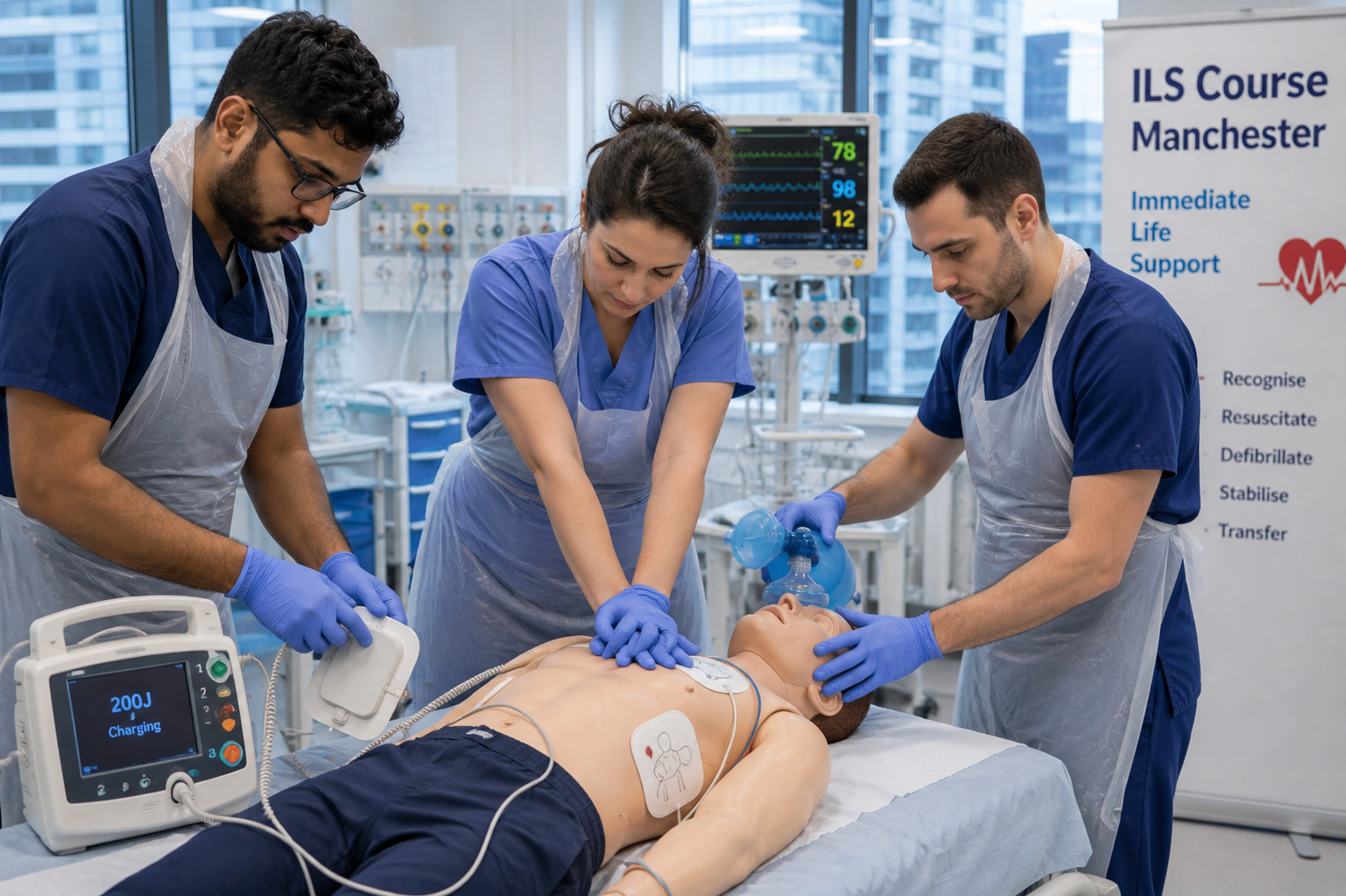
Full-Day Immediate Life Support (ILS) Course in Manchester
Our full-day ILS course in Manchester gives healthcare professionals the practical skills to recognise the deteriorating adult patient, start high-quality CPR, defibrillate…
Mon 5 Oct, PLAB Guide Training Centre
4 places available
-
 View course
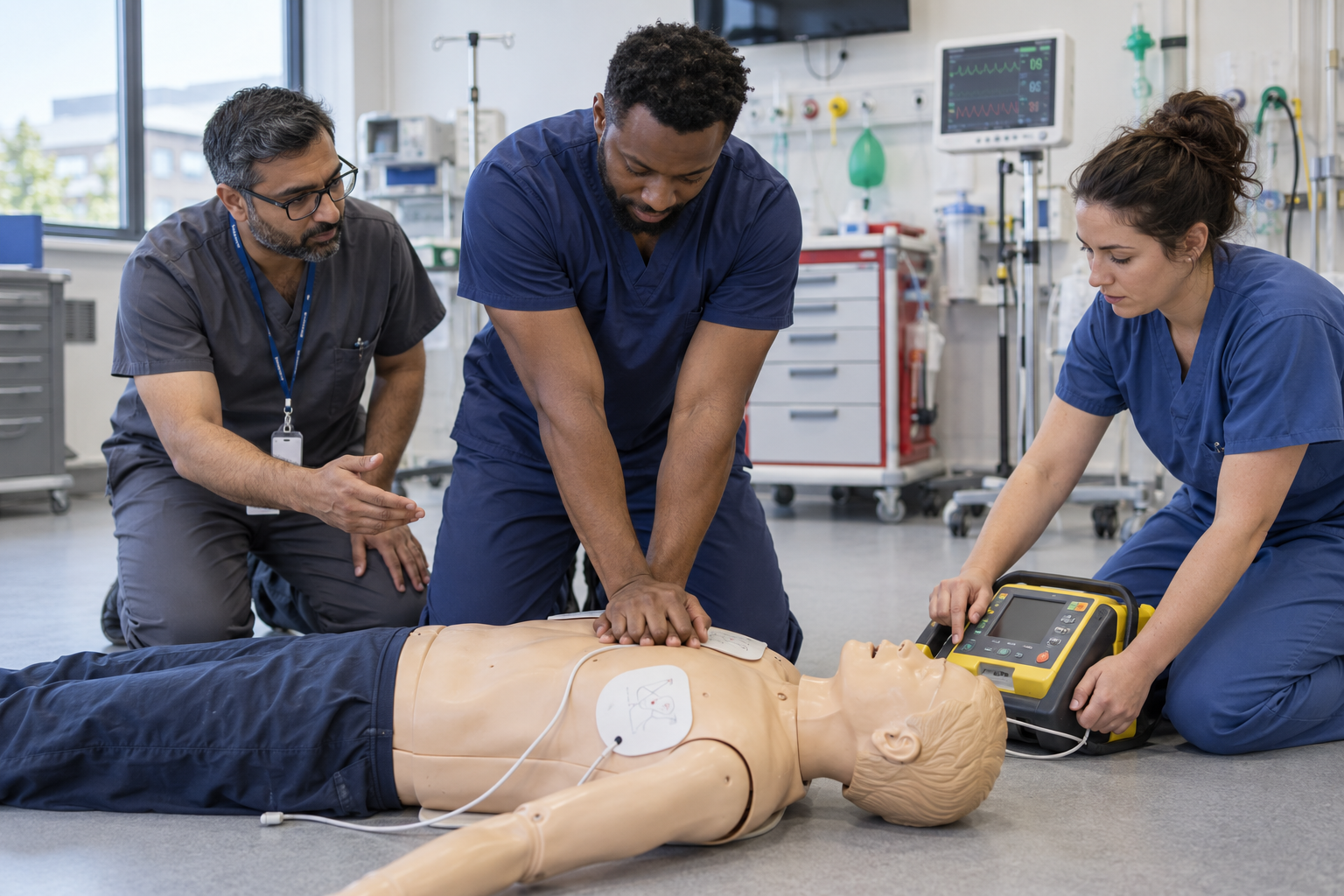
Blended Immediate Life Support (eILS) Course in Manchester
Our eILS course in Manchester is the blended version of the Resuscitation Council UK Immediate Life Support course: you complete the e-learning online, then attend a half-day…
Fri 2 Oct, PLAB Guide Training Centre
5 places available
-
 View course
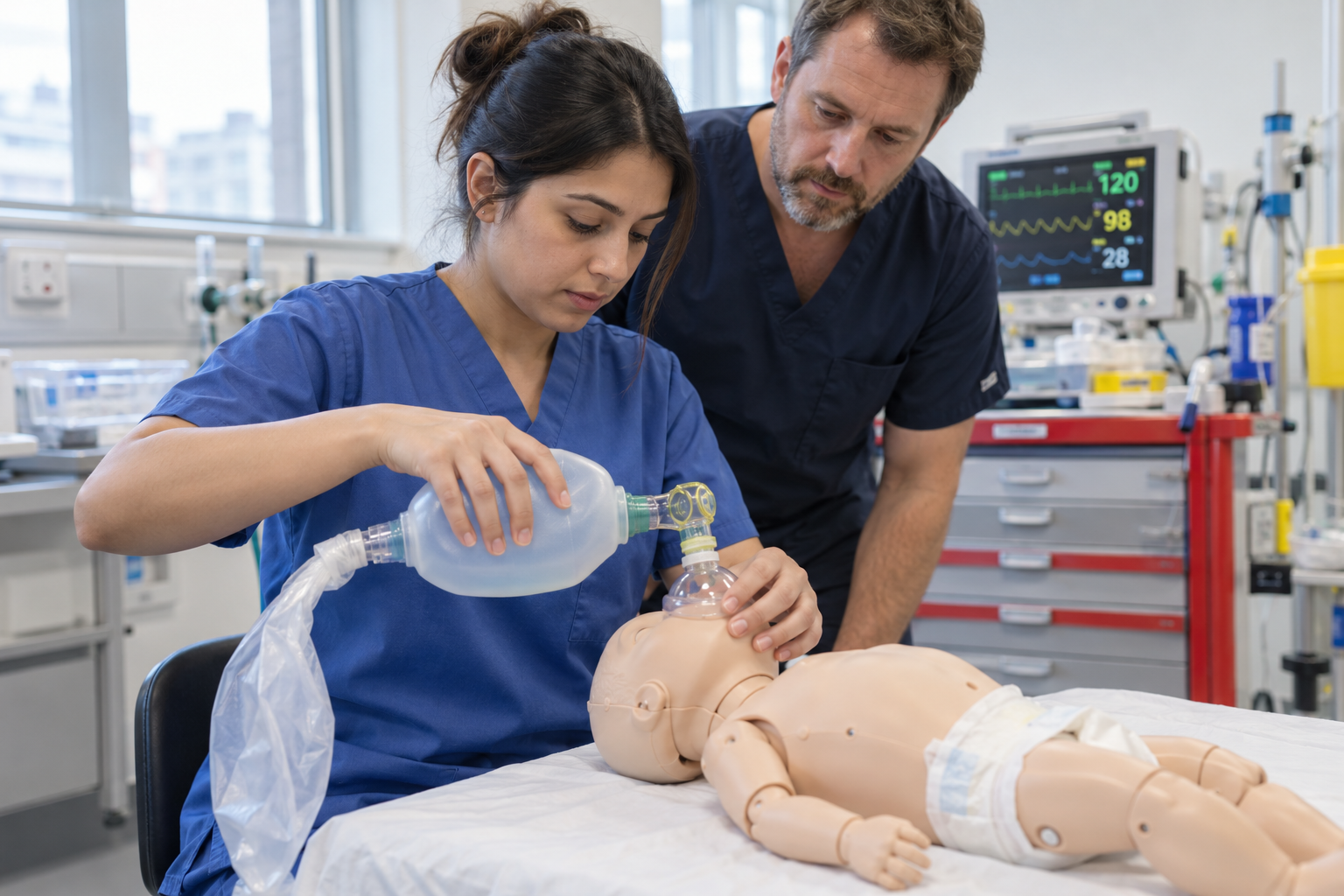
Paediatric Immediate Life Support (PILS) Course in Manchester
This PILS course in Manchester is the Resuscitation Council UK Paediatric Immediate Life Support course, delivered as ePILS: online learning in your own time, then a half-day…
Fri 2 Oct, PLAB Guide Training Centre
6 places available
See all Clinical Skills Courses in Manchester
Frequently asked questions
Can I book just the venepuncture or just the cannulation session?
How many CPD points does the course give?
Will this course sign me off to cannulate or take blood at work?
Do I need venepuncture experience before the cannulation session?
Will I practise on real patients or on each other?
Is the course suitable for students and healthcare assistants?
How much does the course cost?
Where is the training held and is there parking?
Ready to book?
The next date with places is Wednesday 14 October 2026
Book now