PLAB Guide Training Centre in Levenshulme, Manchester runs three hands-on clinical skills courses in the same week every month: venepuncture and cannulation, advanced phlebotomy and cannulation, and urinary catheterisation. They are designed to fit together, so you can start with the basics, build on them later, or book several in one week. This guide explains what each course covers and which one to book first.
The short answer
- You are new to taking blood or cannulating: book the one-day venepuncture and cannulation course, or the two-day advanced course if you want more practice from the start.
- You already take blood and cannulate at work, or did our 1-day course in the last 2 years: book Day 2 only of the advanced course for blood cultures, winged needles and difficult veins.
- You care for patients with catheters: book the catheter care morning of our urinary catheterisation course. If your role includes inserting catheters, book the full day.
Side by side
| Venepuncture and cannulation | Advanced phlebotomy and cannulation | Urinary catheterisation | |
|---|---|---|---|
| Day of the week | Monday | Tuesday and Wednesday | Thursday |
| Length | 1 day, or either half day | 2 days, or Day 2 only | 1 day, or the morning only |
| CPD hours | 6 (3 per half day) | 12 (6 for Day 2 only) | 6 (3 for the morning) |
| What it covers | Venepuncture in the morning, peripheral IV cannulation in the afternoon | Day 1 foundations; Day 2 blood cultures, winged needles, difficult veins, advanced cannulation | Catheter care in the morning; male and female catheterisation and removal in the afternoon |
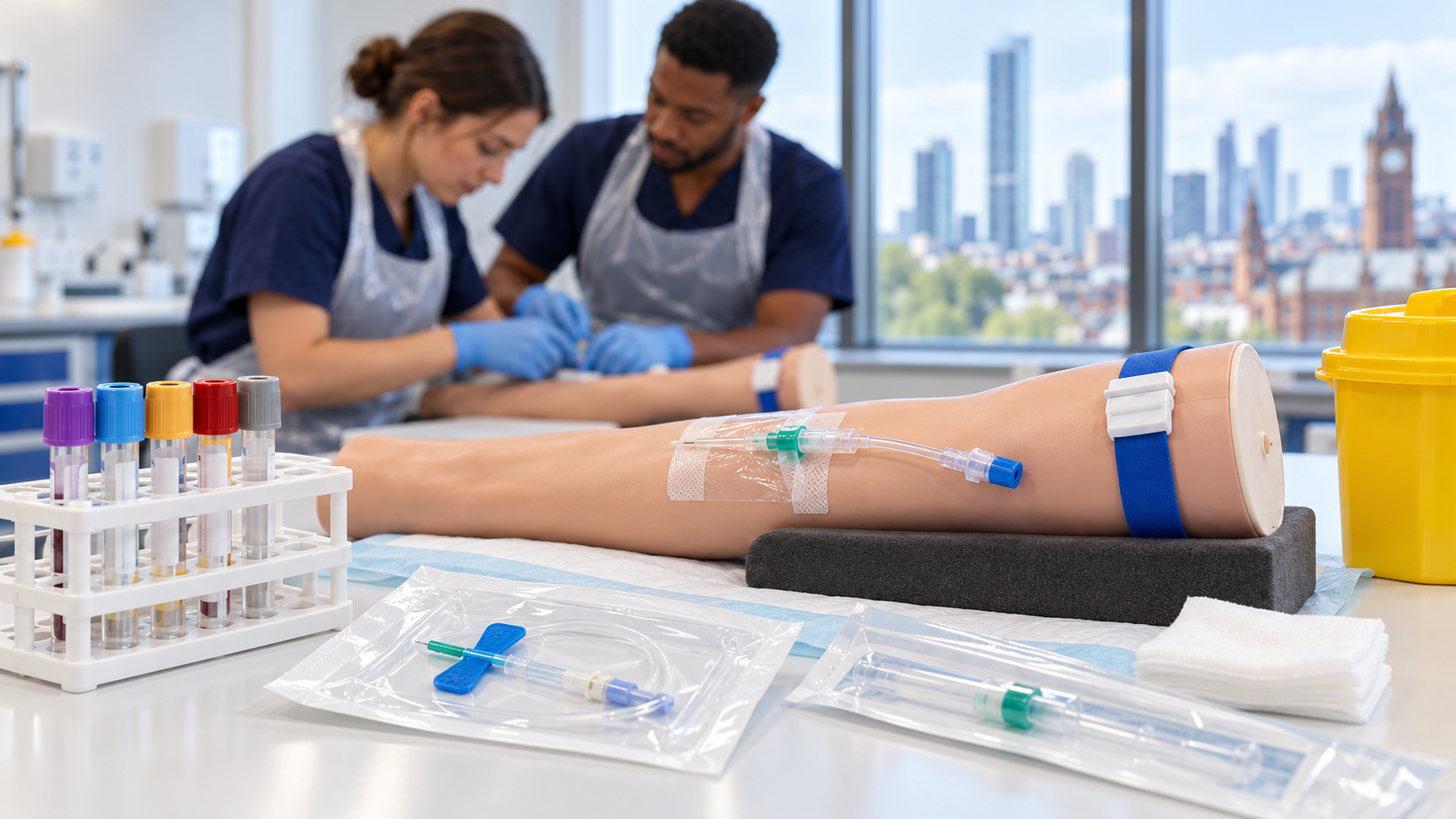
| Practice | Training arms | Training arms, plus optional supervised practice with a volunteer on Day 2 | Male and female anatomical models |
| You leave with | Certificate of attendance with CPD hours | Certificate, observed assessment and a workplace competency record | Certificate after a short online assessment, and a workplace competency record |
How the week fits together
All three courses run in the same week each month, so you can combine them. You can book the advanced course on Tuesday and Wednesday and add urinary catheterisation on Thursday as a 3-day bundle worth 18 CPD hours. Groups are capped at 14 learners on every course.
Venepuncture and cannulation: the foundation
The one-day course teaches you to take blood safely in the morning and insert a peripheral IV cannula in the afternoon, with a trainer watching every attempt on the training arms. It covers vein anatomy and site choice, consent and patient identification, aseptic non-touch technique, order of draw, sharps safety, and inserting, securing and removing a cannula. You can book either half on its own.
Advanced phlebotomy and cannulation: the next step
The two-day course repeats the foundations on Day 1, then moves on to the harder parts of the job on Day 2: winged needle and syringe collection, blood cultures and avoiding contamination, small, fragile and rolling veins, older adults, anxious and needle-phobic patients, and more cannulation practice. Day 2 ends with an observed assessment. If you are confident with the basics, you can book Day 2 only.
Urinary catheterisation: for nurses and care staff
The morning session covers catheter care and suits all care staff, including support workers in care homes: anatomy, infection prevention, catheter types and drainage bags, daily care, suprapubic catheter care and recognising complications. The afternoon covers aseptic male and female urethral catheterisation on models, removal and trial without catheter, for staff whose role includes inserting catheters.
Will I be competent after the course?
Practice on these courses is on training models, apart from the optional supervised volunteer practice on the advanced course. A course does not on its own make you competent to perform the procedure on patients. Your employer supervises you and signs you off in your workplace before you practise on your own. The advanced and catheterisation courses include a competency record to help with this.
Training for your team
We run all three courses for groups of up to 14 at your workplace, including care homes and GP practices. Ask us for a group training quote.