
Immediate & Basic Life Support
Basic Life Support (BLS) and AED Course in Manchester
Our BLS course in Manchester is a one-day, hands-on Qualsafe Level 3 Award in Basic Life Support and Automated External Defibrillation for Adults, Children and Infants (RQF). You will practise CPR on adult, child and infant manikins, use an AED in realistic scenarios and learn the recovery position. It suits healthcare staff, carers, school and nursery teams, workplace first aiders and anyone who may need to respond to a cardiac arrest. Successful candidates gain a regulated Qualsafe certificate.
- Adult, child and infant CPR on dedicated manikins
- Hands-on AED practice for adults, children and infants
- Realistic emergency scenarios and recovery position
- Small-group practical learning
- Assessed by practical demonstration and observation
- Structured feedback from your instructor
- Free dedicated parking at the Levenshulme centre
- Individual and group bookings available
Course summary
- Qualification
- Qualsafe Awards Qualsafe Level 3 Award in Basic Life Support and Automated External Defibrillation for Adults, Children and Infants (RQF)
- Duration
- 3 hours
- Format
- Face-to-face
- Location
- Manchester
- Price
- £49
- Next date
- Monday 16 November 2026
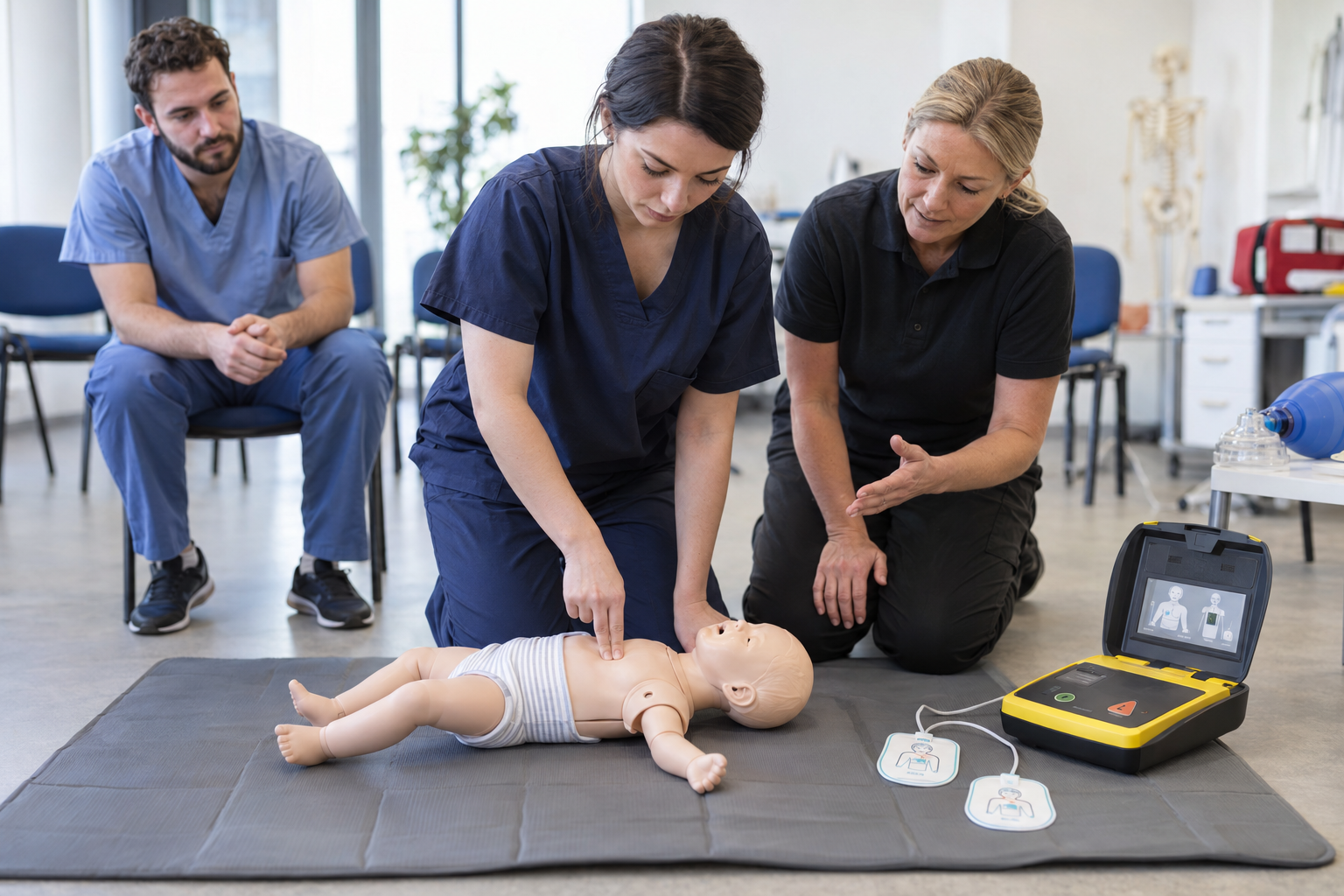
Hands-on BLS and AED training in Manchester
A cardiac arrest can happen to anyone, at any age, and what bystanders do in the first few minutes matters. Our BLS course in Manchester gives you the practical skills to recognise cardiac arrest, start effective CPR and use an automated external defibrillator (AED) on adults, children and infants.
The day is built around practice rather than lectures. You will learn to adapt your technique to the casualty's age, keep chest compressions going with as few pauses as possible and hand over confidently when the ambulance crew arrives.
Choose a date below to book your place online.
Why train with PLAB Guide in Levenshulme
PLAB Guide Training Centre is a Qualsafe Awards Approved Centre (No. 908553), so you leave with a nationally regulated qualification, not just a certificate of attendance.
- Small groups: more time on the manikins and more one-to-one feedback.
- All three age groups: adult, child and infant manikins, with hands-on AED practice for each.
- Realistic scenarios: rehearse the whole sequence, from checking for danger to handing over to paramedics.
- Easy to reach: free dedicated parking on site, free on-road parking nearby and good public transport links.
Further reading
- ILS or eILS: which Immediate Life Support course should you book?: How the full-day and blended routes compare on format, time and price.
- How many first aiders does my workplace need?: What HSE guidance says, and how to choose between EFAW and FAW.
Upcoming dates
£49
Book this dateChoosing a date takes you straight to booking with that date selected.
Course overview
This one-day course combines short, focused theory with extensive hands-on practice. You start with the basics of a safe response: checking for danger, assessing whether the casualty responds, opening the airway and recognising normal and abnormal breathing. From there you move on to calling for help and starting CPR.
Most of your time is spent practising on adult, child and infant manikins. Your instructor coaches you on hand position, compression depth, rate and full recoil, and on delivering effective rescue breaths. The key differences between the three age groups are demonstrated and then practised, so you can adjust your approach to the casualty in front of you.
Using an AED
You will learn how an AED analyses the heart rhythm and prompts a shock. You then use one in realistic scenarios, covering chest preparation, correct pad placement, keeping everyone clear and restarting CPR immediately after a shock. The session also covers practical complications such as a wet chest, heavy chest hair, medication patches and implanted devices, as well as paediatric pads or settings where available.
Scenarios and assessment
The day ends with scenario-based exercises that bring every skill together, including the recovery position and what to do if a casualty vomits. Your instructor assesses you through practical demonstration and observation throughout the course.
Who this course is for
This qualification is for anyone who has a workplace, professional, voluntary or community responsibility to act in a life-threatening emergency. If you could be the first person on scene when an adult, child or baby collapses, it gives you a clear, practised sequence to follow and the confidence to start CPR straight away rather than hesitate.
Please check that a Qualsafe Level 3 BLS and AED award meets the requirements of your employer, regulator or professional body before you book.
Who should attend
- Doctors, nurses and healthcare assistants
- Dental professionals
- Pharmacists and pharmacy staff
- Allied health professionals
- Care-home and domiciliary-care staff
- School and nursery staff
- Sports coaches and fitness professionals
- Workplace first aiders
- Security and public-facing staff
- Community and voluntary-sector workers
- Parents and carers
Entry requirements
The course is highly practical. You need to be able to kneel, bend and perform CPR at floor level for sustained periods. Wear comfortable clothing that lets you move freely on the floor.
If you have an injury or condition that may affect your ability to perform CPR on the floor, contact us at firstaid@plabguide.co.uk before booking.
What you will learn
- Assess an emergency scene safely and reduce risks to yourself, the casualty and bystanders
- Recognise an unresponsive casualty and cardiorespiratory arrest, including abnormal breathing
- Call the emergency services promptly and request an AED
- Deliver high-quality CPR and rescue breaths to adults, children and infants
- Use an AED safely, with correct pad placement and adaptations for children and infants
- Minimise interruptions to chest compressions during AED analysis and shocks
- Place a breathing casualty in the recovery position and monitor them until help arrives
- Manage vomiting or regurgitation and recognise when CPR should continue or stop
Course content
-
1 Emergency assessment and scene safety
A structured first response: checking for danger, assessing responsiveness, opening the airway and deciding whether breathing is normal. -
2 Adult basic life support
Hands-on practice of the full adult CPR sequence, with coaching on compression position, depth, rate and recoil. -
3 Child and infant basic life support
How resuscitation changes for children and babies, from airway positioning and initial rescue breaths to age-appropriate compression techniques. -
4 Using an automated external defibrillator
How an AED works and how to use it safely, including pad placement, following prompts, delivering a shock and resuming CPR without delay. -
5 Recovery position and ongoing care
Caring for a casualty who is breathing but unresponsive, and managing complications such as vomiting during resuscitation. -
6 Emergency scenarios and practical assessment
Realistic scenarios that bring every skill together, observed and assessed by your instructor with structured feedback.
Course format
- Duration
- 3 hours
- Delivery
- Instructor-led teaching, demonstrations and scenario-based practice
- Classroom
- 09:00 – 12:00
Assessment
- How you are assessed
- Practical demonstration and continuous observation by your instructor throughout the day.
- Practical assessment
- Candidates demonstrate adult, child and infant CPR, safe AED use and a correct emergency sequence in practical scenarios.
Certification
- Requirements
- Demonstrate safe, competent performance in assessing an emergency, recognising an unresponsive casualty, performing adult, child and infant CPR, using an AED safely and following an appropriate emergency sequence. Attendance alone does not guarantee a pass.
Training near you
PLAB Guide Training Centre delivers Basic Life Support (BLS) and AED Course in Manchester, convenient for learners travelling from Levenshulme, Longsight, Burnage, Gorton, Didsbury and surrounding areas.
Related courses
You may also like
-
 View course
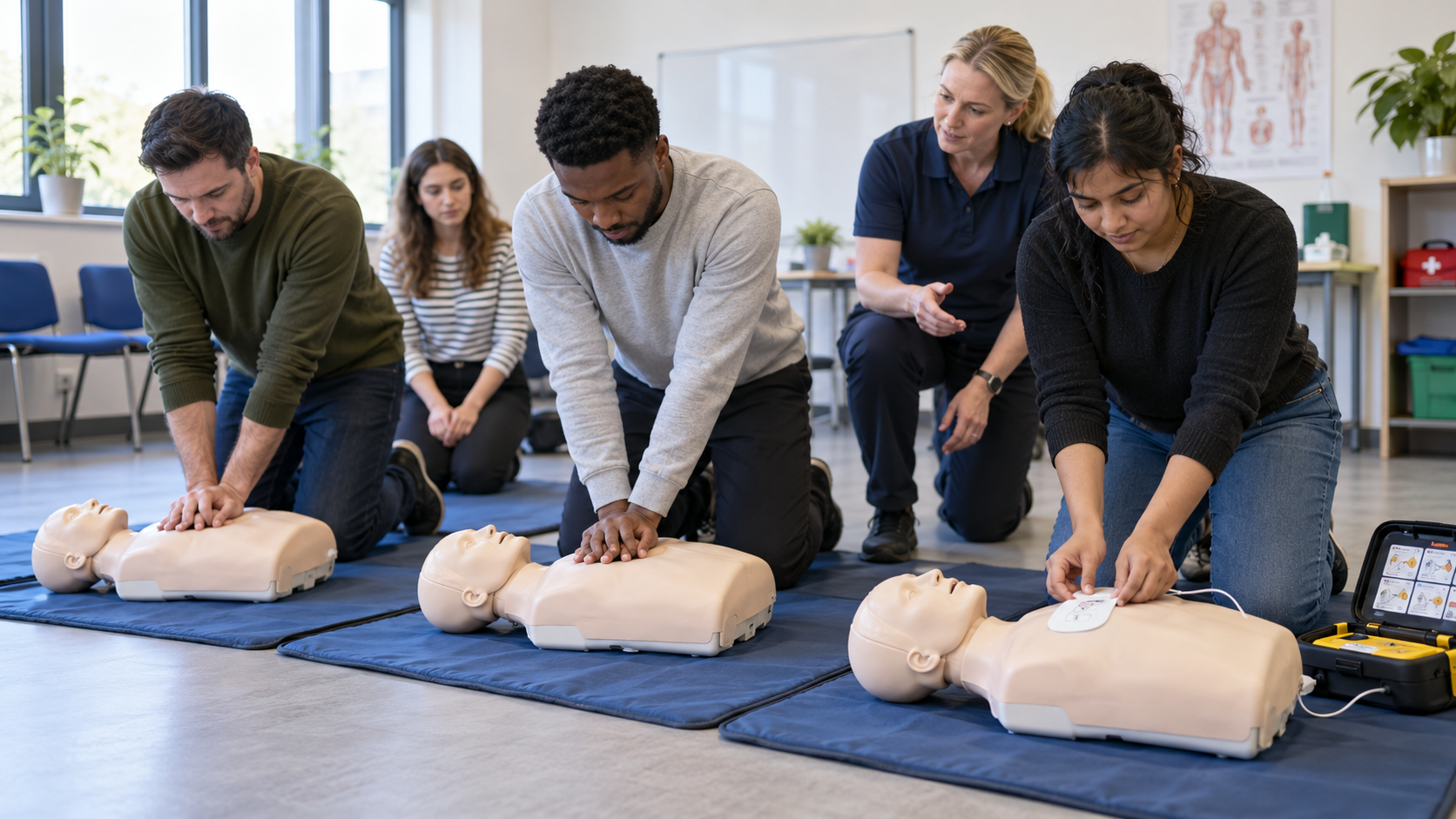
Qualsafe Level 3 First Aid at Work (FAW) Course in Manchester
Our First Aid at Work course in Manchester leads to the Qualsafe Level 3 Award in First Aid at Work (RQF), the regulated qualification for appointed workplace first aiders…
Sun 15 – Mon 16 Nov, PLAB Guide Training Centre
12 places available
Next steps
-
 View course
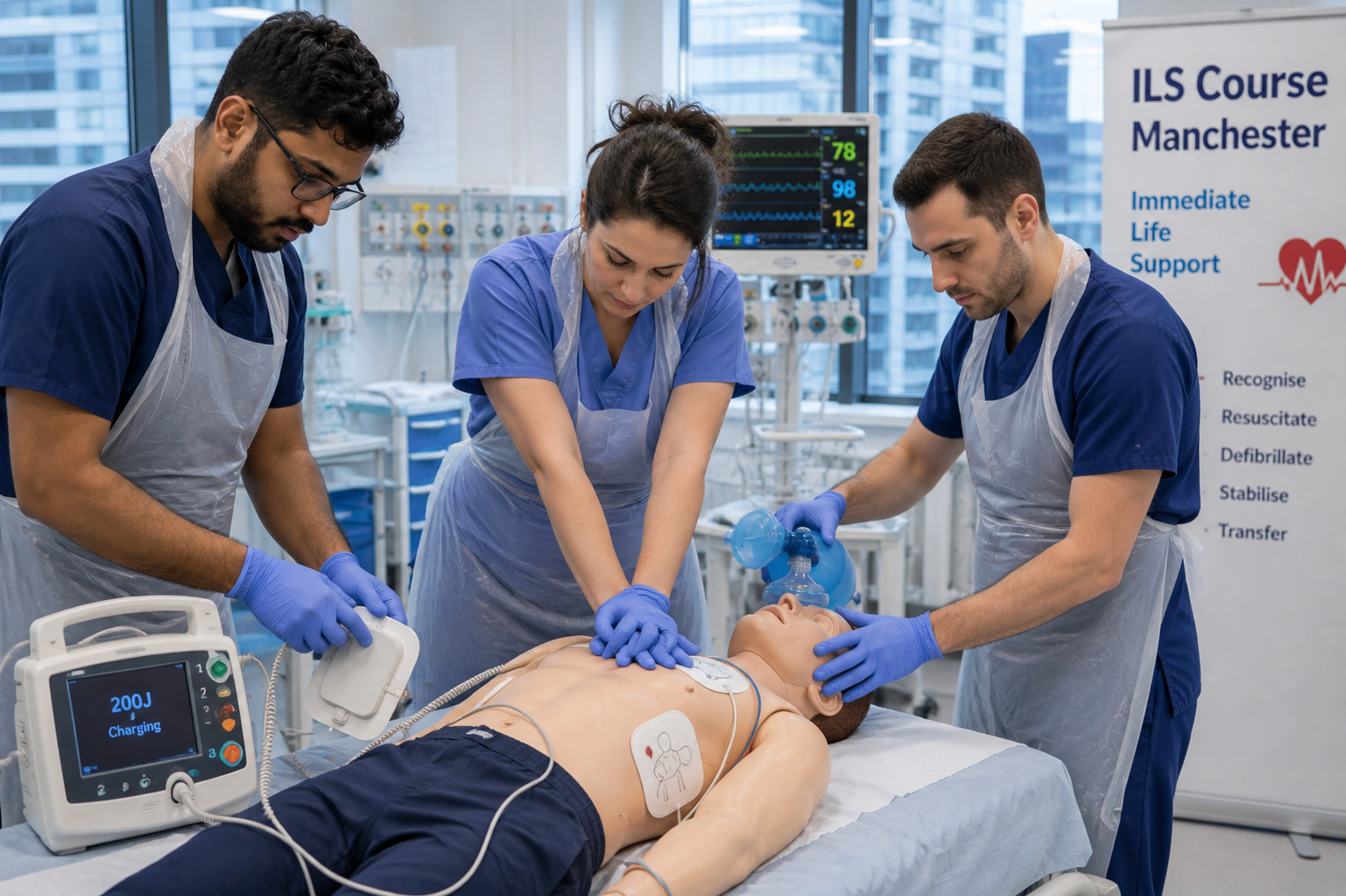
Full-Day Immediate Life Support (ILS) Course in Manchester
Our full-day ILS course in Manchester gives healthcare professionals the practical skills to recognise the deteriorating adult patient, start high-quality CPR, defibrillate…
Mon 9 Nov, PLAB Guide Training Centre
6 places available
-
 View course
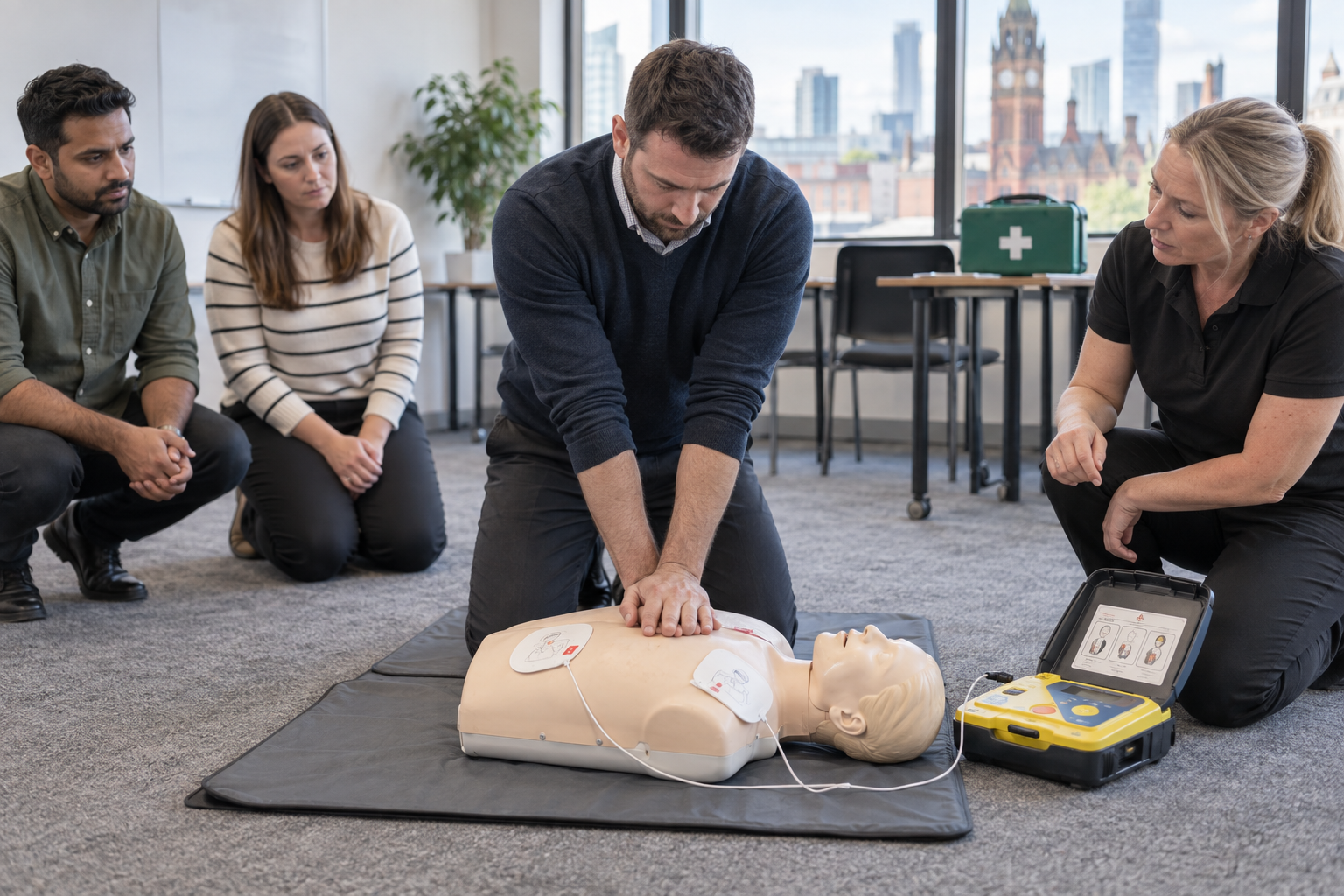
Emergency First Aid at Work (EFAW) Course in Manchester
Our Emergency First Aid at Work course in Manchester is a one-day, hands-on programme that leads to the Qualsafe Level 3 Award in Emergency First Aid at Work (RQF). It is built…
Mon 9 Nov, PLAB Guide Training Centre
12 places available
See all Immediate & Basic Life Support courses
Frequently asked questions
Is this BLS course accredited?
What is the difference between BLS and ILS?
How long is the BLS certificate valid for?
Does the course cover CPR on children and babies?
Is the course physically demanding?
What happens if I don't pass the assessment?
Is there parking at the training centre?
Can you train a group from our organisation?
Ready to book?
The next date with places is Monday 16 November 2026
Book now