
Phlebotomy and Venepuncture Training Course in Manchester
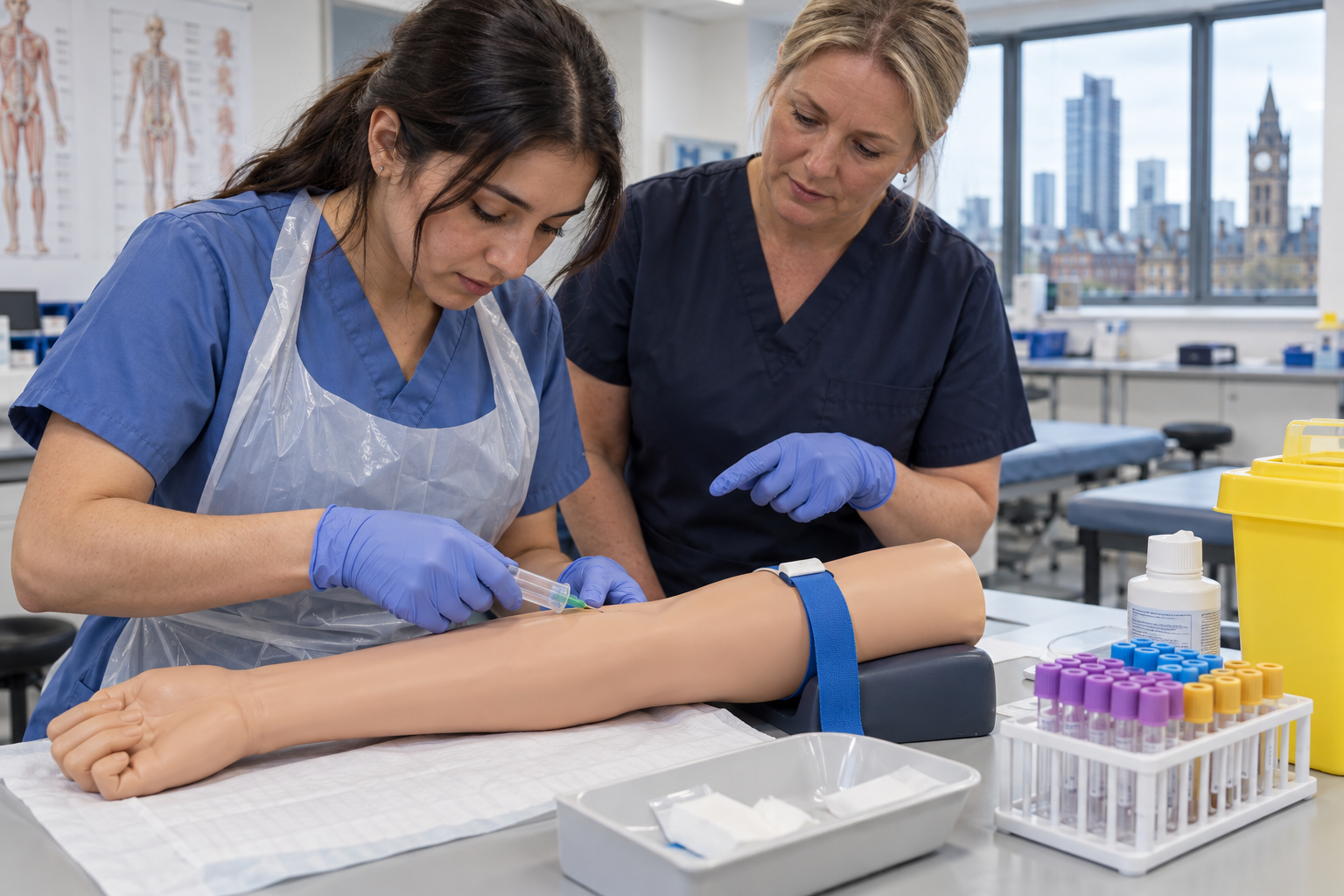
Our phlebotomy course in Manchester gives healthcare professionals, healthcare assistants and students a practical, hands-on grounding in safe venepuncture. You practise vein selection, patient identification, infection prevention, order of draw, specimen labelling and sharps safety on realistic venepuncture arms, with small-group supervision and immediate instructor feedback. Ideal if you are new to taking blood, returning to practice or want more confidence before your employer's competency sign-off.
- Hands-on practice on realistic venepuncture arms
- Small-group teaching with immediate feedback
- Repeated supervised practice of each step
- Covers order of draw, labelling and sharps safety
- Suitable for beginners and returners to practice
- Taught by experienced healthcare instructors
- Free dedicated parking plus free on-road parking
Course summary
- Course
- Phlebotomy and Venepuncture Training Course in Manchester
- Format
- Face-to-face
- Location
- Manchester
- Price
- £180
- Next date
- Saturday 26 September 2026
Upcoming dates
£180
Book this dateChoosing a date takes you straight to booking with that date selected.
Course content
-
1 Role, responsibilities and venous anatomy
Why blood is taken and the responsibilities of the person taking it. A review of the superficial veins of the upper limb – median cubital, cephalic, basilic and dorsal hand veins – and the arteries and nerves that lie close to them.By the end of this part you will be able to:
- Locate the median cubital, cephalic and basilic veins
- Assess vein size and stability before choosing a site
- Name the sites and nearby structures to avoid
-
2 Patient identification, consent and positioning
Safe phlebotomy starts before the needle goes in. Confirm the patient and the blood request, explain the procedure, check relevant allergies and previous difficulties, and position patients who may faint safely.By the end of this part you will be able to:
- Use a consistent identity and request check
- Recognise patients at risk of fainting before starting
-
3 Infection prevention and equipment
Hand hygiene, personal protective equipment, skin preparation and aseptic technique. Hands-on familiarisation with tourniquets, needles, butterfly devices, vacuum collection systems, syringes, gauze and sharps containers, and how equipment choice changes with the patient and setting.By the end of this part you will be able to:
- Choose between a straight needle and a butterfly device
- Manage a blood exposure incident
-
4 Blood tubes, order of draw and specimen handling
Common blood tubes, their additives and typical investigations. Correct order of draw, gentle mixing, avoiding haemolysis, accurate labelling and safe transport to the laboratory, always within local laboratory policy.By the end of this part you will be able to:
- Explain why the order of draw matters
- Reduce the risk of haemolysed samples
-
5 Practical venepuncture technique
A structured procedure practised repeatedly on realistic venepuncture arms under instructor supervision, from applying the tourniquet to sharps disposal, checking the patient and documenting the procedure.By the end of this part you will be able to:
- Release the tourniquet at the right moment
- Recognise successful venous access
- Document the procedure where required
-
6 Difficult situations and complications
Poorly visible, fragile or hard-to-palpate veins, dehydrated or anxious patients, needle phobia and slow blood flow. Recognising and managing haematoma, bleeding, pain, fainting, nerve irritation, infection, accidental arterial puncture and failed attempts.By the end of this part you will be able to:
- Decide when to stop and escalate rather than try again
- Respond to a haematoma or suspected arterial puncture
Course format
- Delivery
- Small-group practical workshops using venepuncture simulation arms
Certification
- Requirements
- Attend the whole course and complete the practical training successfully.
Training venue
See all Clinical Skills Courses in Manchester
Frequently asked questions
Do I need any experience before booking a phlebotomy course?
Will I be a qualified phlebotomist after the course?
What equipment will I practise with?
Is there parking at the Manchester venue?
How much does the phlebotomy course cost?
I trained outside the UK. Is this course relevant to me?
Are blood tube colours the same in every hospital?
What if I struggle to find a vein during the course?
Ready to book?
The next date with places is Saturday 26 September 2026
Book now