
Peripheral IV Cannulation Course in Manchester
Our peripheral IV cannulation course in Manchester gives healthcare professionals structured, hands-on practice in inserting, securing and caring for a peripheral intravenous cannula. Working in small groups on realistic training arms, you build a safe, repeatable technique with immediate feedback from experienced healthcare instructors. Ideal for doctors, nurses, paramedics, physician associates and international medical graduates starting UK practice, or anyone needing a refresher before workplace sign-off. You receive a certificate on completion.
- Small-group teaching with individual feedback
- Realistic IV cannulation training arms
- Repeated hands-on insertion practice
- Aseptic non-touch technique built into every attempt
- Covers securing, flushing and ongoing cannula care
- Difficult veins and complications covered
- Free dedicated parking, plus nearby on-road parking
New dates are being scheduled
There are no dates open for booking right now. Ask us and we will let you know when the next one is scheduled, or arrange the course for your own team.
Ask about datesCourse summary
- Course
- Peripheral IV Cannulation Course in Manchester
- Duration
- 2-day face-to-face course
- Format
- 1 day online learning + 1 day face-to-face practical training
- Location
- Manchester
- Price
- £180
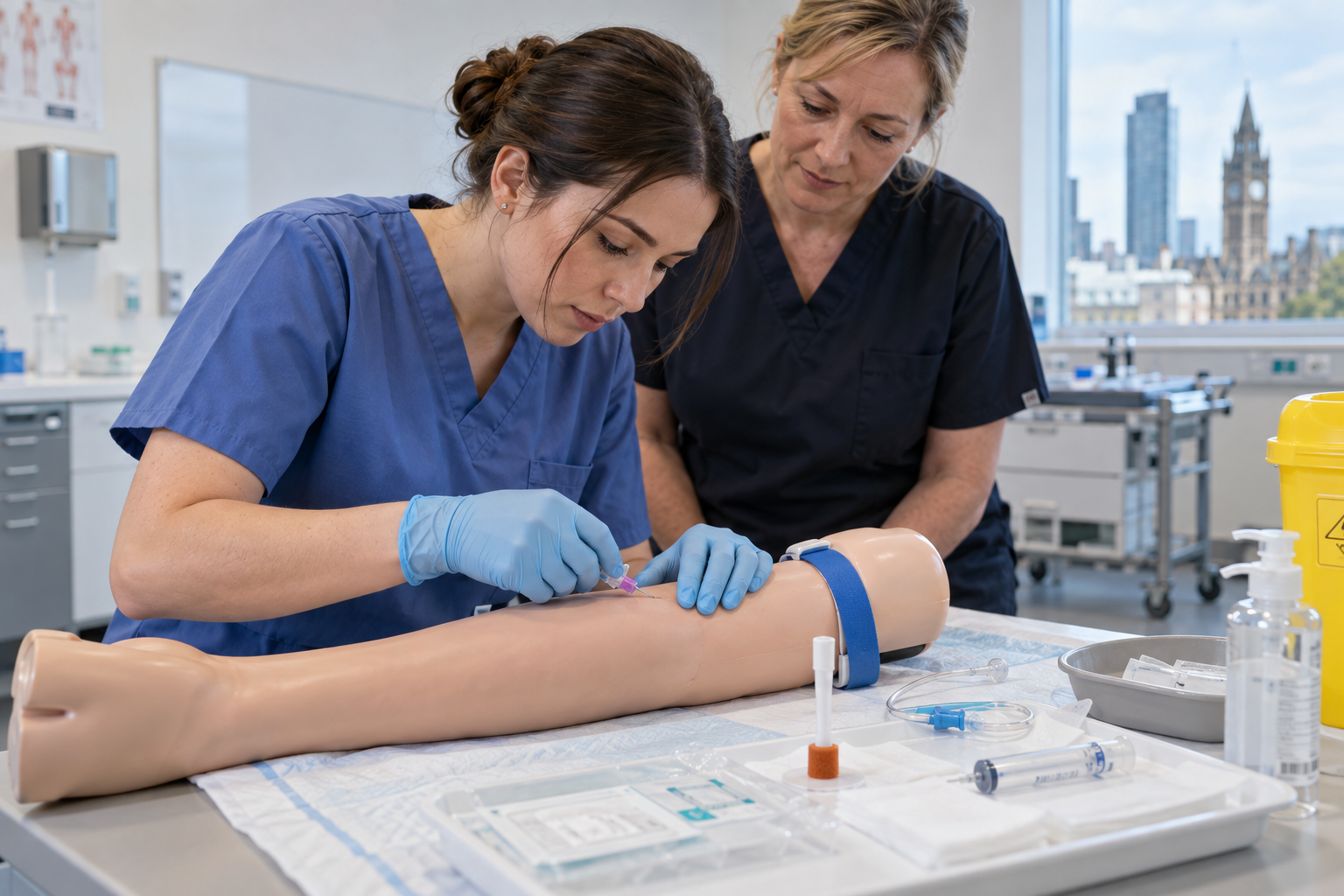
Hands-on IV cannulation training in Manchester
Knowing the steps of cannulation is not the same as placing a cannula confidently on a real patient. This cannulation course in Manchester closes that gap. You spend much of the session with a cannula in your hand, working on realistic training arms at our centre in Levenshulme, while an instructor watches your angle, flashback and securement and corrects your technique on the spot.
The course suits clinicians learning peripheral IV access for the first time, those returning to practice and anyone who knows the theory but lacks the confidence. Choose a date below and reserve your place in a small group.
Why train in cannulation with PLAB Guide
Our instructors are experienced healthcare professionals who keep the training grounded in UK clinical practice. Aseptic non-touch technique, local policy and documentation run through every attempt, rather than being added at the end.
- Small groups, so you get individual attention and immediate correction
- Realistic training arms and a range of cannula sizes to handle
- Repeated practice until your technique is safe, structured and reproducible
- Free dedicated parking at the centre, plus free on-road parking nearby
Upcoming dates
New dates are being scheduled
There are no dates open for booking right now. Ask us and we will let you know when the next one is scheduled, or arrange the course for your own team.
Ask about datesCourse overview
The course takes you through peripheral intravenous access, from the decision to cannulate to caring for the device afterwards. It starts with the essentials: when IV access is indicated, contraindications and precautions, and the upper-limb venous anatomy that guides site selection. This covers the dorsal hand, forearm, cephalic, basilic and antecubital veins, and the arteries and nerves to steer clear of.
You then look at cannula selection. You learn to match the device to the indication, flow rate, fluid or medication, vessel size and expected duration of therapy, choosing the smallest suitable cannula in the most appropriate vein. Infection prevention runs throughout: hand hygiene, PPE, skin antisepsis, aseptic non-touch technique and safe sharps disposal.
Most of the course is hands-on simulation. You practise a structured insertion sequence on realistic arms until each step is repeatable. You then work through difficult access, recognising complications, cannula care and documentation.
After the course
This is structured theory and simulation training. Completing it does not by itself certify independent competence or authorise you to cannulate. You may still need supervised cannulations, direct observation, a competency logbook and employer sign-off under local policy.
Who this course is for
This course is for healthcare professionals who need peripheral IV access as part of their role and want to perform it safely and systematically. You might understand the theory but feel unsure at the bedside. You might be returning to clinical work after a break, or be an international medical graduate adjusting to UK practice and local policies. It also suits anyone who learned cannulation some time ago and wants a structured refresher, or who needs extra simulation practice before a workplace sign-off.
Who should attend
- Doctors, including foundation doctors
- Nurses and nursing associates
- Healthcare assistants where cannulation forms part of their approved role
- Paramedics
- Advanced clinical practitioners
- Physician associates
- International medical graduates entering UK clinical practice
- Medical and nursing professionals returning to practice
Entry requirements
Previous venepuncture experience is helpful, particularly if you are new to vascular access.
Healthcare assistants should attend only where cannulation forms part of their approved role. All candidates remain responsible for working within their professional scope and their organisation's policies after the course.
What you will learn
- Identify appropriate indications for peripheral IV access
- Assess veins and select a suitable site and cannula size
- Prepare the patient and equipment, including identity checks and consent
- Apply hand hygiene and aseptic non-touch technique throughout
- Perform peripheral cannulation on a simulation arm using a structured sequence
- Confirm placement, then flush, secure and dress the cannula
- Recognise complications such as infiltration, extravasation and phlebitis
- Manage a failed attempt and know when to escalate
Course content
-
1 Indications and venous anatomy
When peripheral IV access is appropriate, along with contraindications and precautions. Covers the dorsal hand, forearm, cephalic, basilic and antecubital veins, and the nearby arteries and nerves to avoid. -
2 Choosing the cannula and preparing the patient
Common cannula sizes and how indication, flow rate, fluid type, vessel size and duration of therapy guide the choice. Confirming identity, explaining the procedure, gaining consent, asking about previous difficult access and positioning the patient. -
3 Infection prevention and aseptic non-touch technique
Hand hygiene, PPE, skin antisepsis and protecting key parts from contamination. Preparing equipment before you start and disposing of sharps safely. -
4 Step-by-step insertion technique
A structured sequence from confirming the indication to documenting insertion, including tourniquet use, observing flashback, lowering the angle, advancing the catheter, releasing the tourniquet and confirming patency. -
5 Hands-on simulation practice
Repeated insertion practice on realistic cannulation arms, working on needle and catheter control and on connecting and securing the device, with immediate instructor feedback on each attempt. -
6 Difficult cannulation and complications
Poorly visible, rolling and fragile veins, oedema, dehydration and anxious patients. Recognising haematoma, infiltration, extravasation, phlebitis, occlusion, arterial puncture and needlestick injury, and knowing when to stop and escalate, including to ultrasound-guided access. -
7 Cannula care, documentation and sign-off
Keeping the dressing clean, assessing the site, maintaining patency under local policy and removing the cannula when it is no longer needed. Documenting the procedure and planning supervised practice towards workplace sign-off.
Course format
- Duration
- 2-day face-to-face course
- Made up of
- 1 day online learning + 1 day face-to-face practical training
- Delivery
- Small-group practical simulation on cannulation training arms
Assessment
- How you are assessed
- Instructors observe your technique on the training arms throughout the course and give immediate feedback and correction on each attempt.
Training venue
See all Clinical Skills Courses in Manchester