


Page 55 - Demo
P. 55
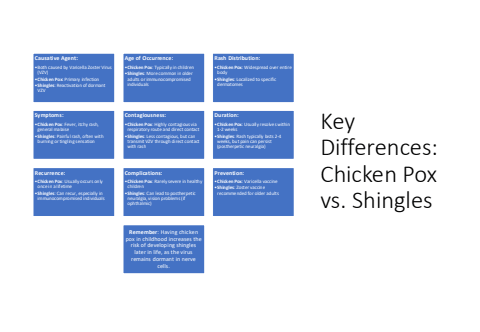
Key Differences: Chicken Pox vs. ShinglesCausative Agent:%u2022Both caused by Varicella Zoster Virus (VZV)%u2022Chicken Pox: Primary infection%u2022Shingles: Reactivation of dormant VZVAge of Occurrence:%u2022Chicken Pox: Typically in children%u2022Shingles: More common in older adults or immunocompromised individualsRash Distribution:%u2022Chicken Pox: Widespread over entire body%u2022Shingles: Localized to specific dermatomesSymptoms:%u2022Chicken Pox: Fever, itchy rash, general malaise%u2022Shingles: Painful rash, often with burning or tingling sensationContagiousness:%u2022Chicken Pox: Highly contagious via respiratory route and direct contact%u2022Shingles: Less contagious, but can transmit VZV through direct contact with rashDuration:%u2022Chicken Pox: Usually resolves within 1-2 weeks%u2022Shingles: Rash typically lasts 2-4 weeks, but pain can persist (postherpetic neuralgia)Recurrence:%u2022Chicken Pox: Usually occurs only once in a lifetime%u2022Shingles: Can recur, especially in immunocompromised individualsComplications:%u2022Chicken Pox: Rarely severe in healthy children%u2022Shingles: Can lead to postherpetic neuralgia, vision problems (if ophthalmic)Prevention:%u2022Chicken Pox: Varicella vaccine%u2022Shingles: Zoster vaccine recommended for older adultsRemember: Having chicken pox in childhood increases the risk of developing shingles later in life, as the virus remains dormant in nerve cells.


