


Page 24 - Demo
P. 24
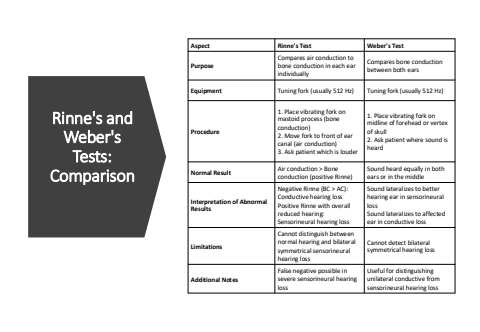
Rinne's and Weber's Tests: ComparisonAspect Rinne's Test Weber's TestPurposeCompares air conduction to bone conduction in each ear individuallyCompares bone conduction between both earsEquipment Tuning fork (usually 512 Hz) Tuning fork (usually 512 Hz)Procedure1. Place vibrating fork on mastoid process (bone conduction) 2. Move fork to front of ear canal (air conduction) 3. Ask patient which is louder1. Place vibrating fork on midline of forehead or vertex of skull 2. Ask patient where sound is heardNormal Result Air conduction > Bone conduction (positive Rinne)Sound heard equally in both ears or in the middleInterpretation of Abnormal ResultsNegative Rinne (BC > AC): Conductive hearing loss Positive Rinne with overall reduced hearing: Sensorineural hearing lossSound lateralizes to better hearing ear in sensorineural loss Sound lateralizes to affected ear in conductive lossLimitationsCannot distinguish between normal hearing and bilateral symmetrical sensorineural hearing lossCannot detect bilateral symmetrical hearing lossAdditional NotesFalse negative possible in severe sensorineural hearing lossUseful for distinguishing unilateral conductive from sensorineural hearing loss


